

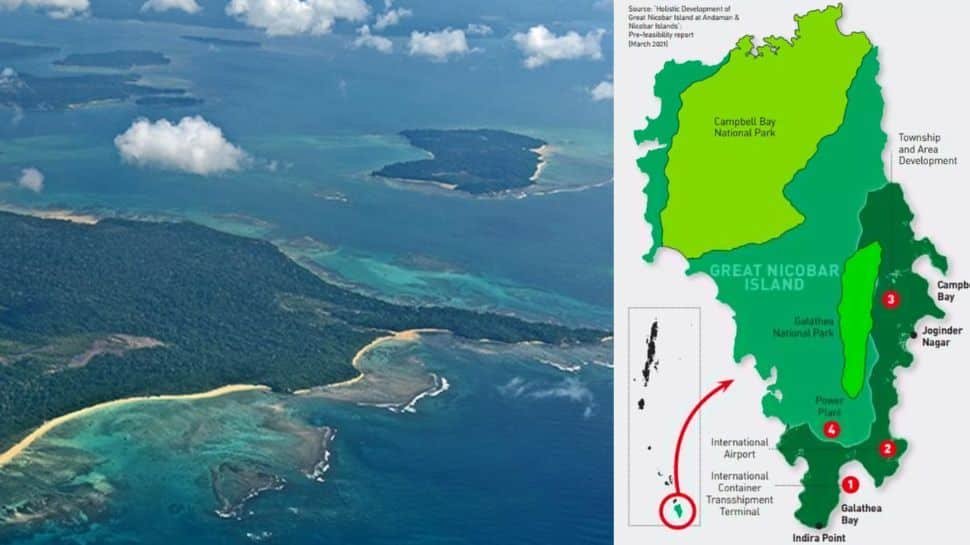
India launches a massive ₹72,000 crore infrastructure initiative on Great Nicobar Island, aiming to establish a transshipment port, international airport, power plant, and township. Dubbed a potential ‘India’s Hong Kong,’ this project seeks to enhance strategic positioning and economic growth near the Strait of Malacca. However, it sparks debates over tribal displacement, threats to a UNESCO biosphere reserve, and vulnerabilities in a seismically active region. The island lies just 9 km from India’s southern mainland, 210 km from Indonesia’s Aceh, and 900 km from the Malacca Strait, positioning it as a key node for southeastern transshipment routes and a counter to regional encirclement strategies in the Indian Ocean.
What is the Great Nicobar Project?
The Great Nicobar Island Development Project represents a flagship ₹72,000-81,800 crore plan for the southern Andaman & Nicobar Islands, initiated by NITI Aayog in 2021 and greenlit by the Union Cabinet. This 30-year phased development includes an International Container Transshipment Terminal (ICTT) at Galathea Bay, with Phase 1 set for completion by 2028 and a capacity of 4 million TEUs. Operated under naval supervision, the terminal reduces dependence on foreign ports like Colombo and Singapore.
Additional features encompass a greenfield international airport for civilian and military use, emphasizing tourism; two coastal townships to house 65,000 people across 166 sq km; a 450 MVA gas-solar hybrid power plant for reliable energy; a free trade zone; a cruise terminal; ship repair facilities; and expanded tourism infrastructure. These elements integrate to bolster India’s maritime and economic presence in the Indo-Pacific.
Strategic Advantages and Economic Potential
Government projections estimate the transshipment port could yield ₹30,000 crore in annual revenue by 2040, while generating 50,000 jobs. Aligned with the Sagarmala initiative, the project promotes port-led coastal development across India. Galathea Bay’s natural deep-water harbor minimizes dredging needs, establishing India as a vital maritime gateway to Southeast Asia.
Located near the Malacca Strait—which handles 80% of China’s oil imports—the site offers oversight of major shipping lanes. The ICTT and dual-use airport enable continuous naval monitoring of the Malacca, Sunda, and Lombok Straits, providing leverage against regional threats. Situated 150 km from Indonesia and overlooking the Six Degree Channel—a chokepoint for 55% of India’s trade—the development enhances tri-services power projection.
The Andaman and Nicobar Islands host India’s sole tri-service theater command. Upgrades here support P-8I maritime patrol aircraft, BrahMos cruise missiles, and naval assets, extending deterrence near the South China Sea. This setup counters submarine threats and secures eastern Indian Ocean routes, especially amid instability in Myanmar. The deep-water port facilitates carrier operations, drone deployments, and logistics, effectively turning Nicobar into an ‘unsinkable aircraft carrier’ under the SAGAR doctrine.
Ecological and Social Challenges
Great Nicobar stands as one of the world’s most biodiverse yet disaster-prone areas, designated a UNESCO Biosphere Reserve. The project risks 130 sq km of deforestation and violations of Coastal Regulation Zone (CRZ)-1A rules, endangering mangrove forests, coral reefs, and leatherback turtle nesting sites at Galathea Bay. Seismic hazards, heightened by the 2004 tsunami, add to the vulnerabilities.
The Shompen tribe, classified as a Particularly Vulnerable Tribal Group (PVTG), along with the Nicobarese, faces cultural disruption from population influxes and land acquisition. The National Green Tribunal (NGT) and Supreme Court currently examine expedited environmental impact assessments, classified defense documents, and proposed compensatory afforestation in distant Haryana.
This ambitious endeavor promises to reshape trade dynamics, monitor regional powers, and foster economic growth through tourism and operations. Yet, it demands careful balancing of security gains against ecological and tribal preservation to ensure sustainable progress in the Indo-Pacific.
