

Nationwide Height Corrections Enhance Geodetic Accuracy
The Ministry of Land, Infrastructure and Transport has recalibrated the actual central gravity values for 10,479 national geodetic control points, including water level and tidal benchmarks that serve as the foundation for sea-level heights. Officials announced these updates on January 23, introducing newly surveyed and reflected measurements.
Average height adjustments across the country stand at 0.7 cm, with regional variations such as 0.8 cm in Gyeongju, 1.3 cm in Sanji, and 0.4 cm in Pyeongji. These corrections ensure precise height data tied to sea-level baselines.
Historical Challenges and Recent Advances
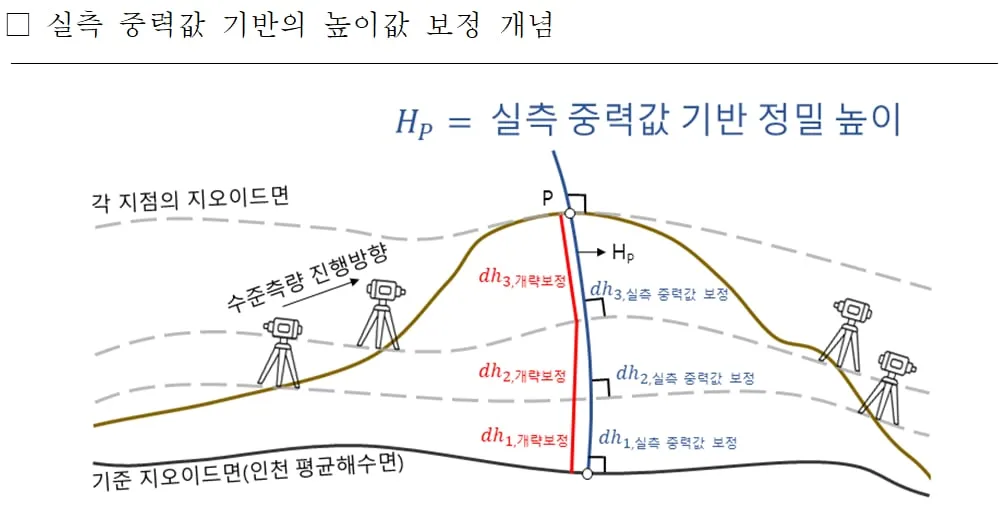
National geodetic control points require exact central gravity values to accurately convert explosion-based heights to sea-level equivalents. Since the 1960s, direct measurement of central gravity thickness proved impossible, leading to reliance on reported estimates.
Korea’s sea-level zero point at Incheon’s Sujeonwonjeom (26.6871 m) exceeds landmarks like Daegwanreung, complicating height calculations for elevated sites. Actual central gravity values could not factor into these computations.
To address this, teams conducted major gravity surveys from 2009 to 2024, completing thickness data for water and tidal control points totaling 10,479 sites. Corrected height values became public on January 26.
Impact on Surveys and Infrastructure
Nationwide, heights at national control points—spaced about 2 km apart—now reflect true central gravity adjustments. Mountain survey points and interconnected benchmarks saw corrections ranging from 5 to 6 cm, finalizing the update scope.
The ministry urges users affected by these changes, such as river basin modelers, to adopt uniform height levels for calculations. Critical sites like airports and urban centers—about 2% of total points—face significant shifts up to 5 cm.
National Geographic Information Institute Director Kim Moo-daeng stated, “These national benchmark height improvements position South Korea as a global geodesy leader.” He added, “Ongoing GNSS-based real-time height surveys will advance the national geoid model, delivering convenient and precise height infrastructure nationwide.”
