

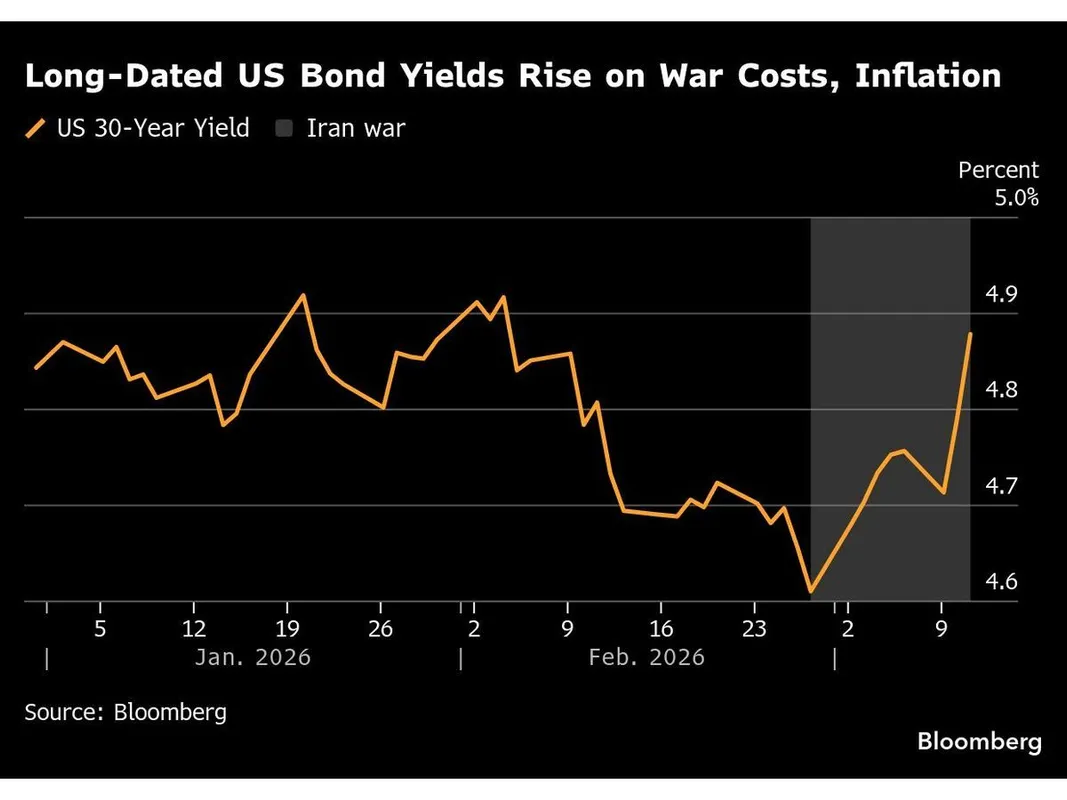
Investors show increasing concern over the mounting costs of the ongoing US-Israel-Iran conflict, pushing long-term government bonds lower as deficit pressures intensify. The 30-year US Treasury yield climbs to nearly 4.90%, its highest in a month, reflecting expectations that military operations will expand the federal budget shortfall.
Fiscal worries from the conflict ripple through global bond markets, elevating yields in the UK, Germany, Australia, and Japan. Markets anticipate greater borrowing to fund defense needs and protect households from elevated energy prices.
US Fixed-Income Market Volatility
War expenses heighten anxiety over substantial existing deficits, prompting investors to seek higher returns on long-dated bonds. Surging energy prices add inflationary risks, creating challenges for bondholders.
“Long-end rates tell a fiscal and government credibility story,” explains Gang Hu, managing partner at Winshore Capital Partners. “They signal the need for spending on the war and oil price subsidies for consumers.”
The US-Israel-Iran conflict, underway since February 28, triggers sharp swings in worldwide markets. President Donald Trump stated Wednesday that it could wrap up soon without a firm timeline, adding, “we’re not finished yet.”
A $22 billion auction of 30-year Treasuries on Thursday will reveal investor demand. Yields rise across maturities since the conflict’s start, first driven by short-term bonds on oil-fueled inflation fears influencing Federal Reserve expectations.
Longer-term bonds now face heavier selling, with 30-year yields up 13 basis points this week versus 9 basis points for two-year notes. Attention turns to prolonged conflict’s budget strain.
“War financing and broader growth slowdowns weigh heavily,” notes Ruben Hovhannisyan, generalist portfolio manager in TCW’s fixed income group.
The US deficit narrows lately but reaches about $1 trillion in the five months through February. A Supreme Court ruling overturning trade tariffs eliminates billions in revenue.
“Tariff reversals prove inflationary, as do wars—this widens the deficit,” says Matt Eagan, portfolio manager at Loomis, Sayles & Co., managing over $430 billion.
Worldwide Government Borrowing Pressures
Nations ramped up spending in the 2022 energy crisis after Russia’s Ukraine invasion. Limited fiscal room, rising debt, and interest expenses today make bond markets demand steeper real yields for new outlays.
“Bond investors may resist funding such expansion without higher rewards,” observes Chris Arcari, head of capital markets at Hymans Robertson.
Europe Grapples with Defense and Energy Costs
European leaders eye boosted defense budgets and energy aid if oil stays high. European Commission President Ursula von der Leyen suggests options like a gas price cap.
Crisis response may mirror 2022 with shared EU bond issuance for support.
“Joint EU debt issuance offers a clear path forward,” affirms Andrzej Szczepaniak, senior European economist at Nomura.
Asia Faces Heightened Spending Demands
Australia, Singapore, and Japan expand defense allocations, with Japan targeting record levels. The conflict threatens even larger commitments, stalling fiscal tightening.
“Inflation outlooks lift yields across Asia, including Japan,” states Carol Kong, strategist at Commonwealth Bank of Australia.
China’s markets, typically stable, see 30-year yields at 2024 peaks from inflation risks.
Global debt issuance surges could challenge the $31 trillion US Treasury market as investors chase superior yields. Extended fighting and spending spur ongoing premium demands for long bonds.
“Rising Treasury supply coincides with buyer shortages. 30-year appeal returns only above 5%,” forecasts Matt Eagan at Loomis Sayles & Co.
