

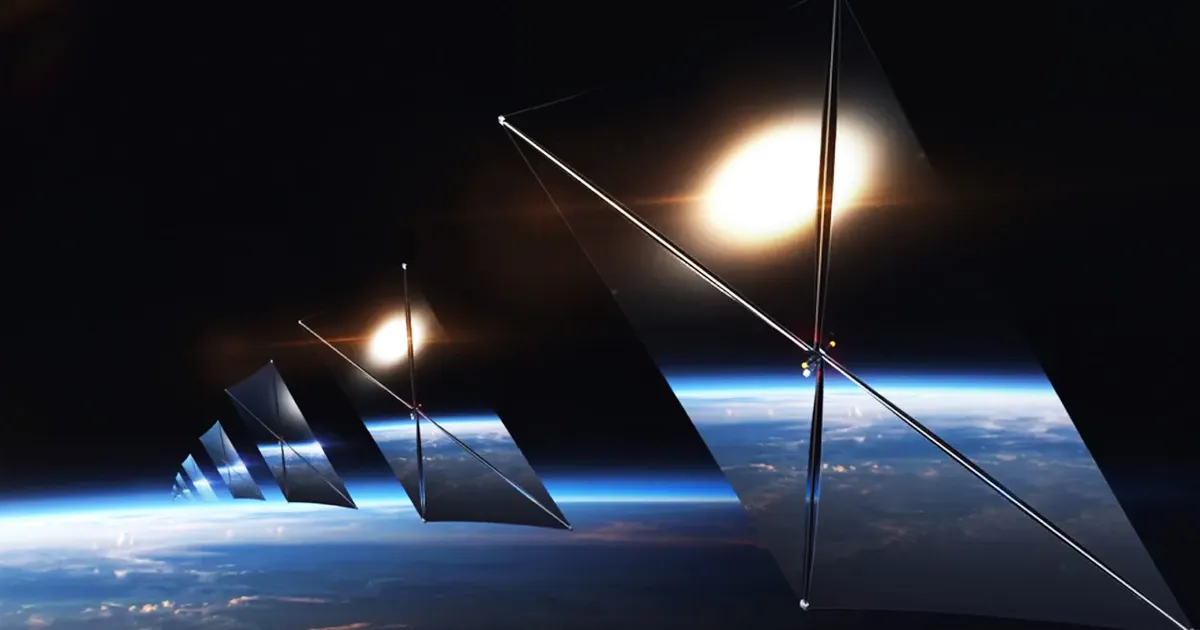
The U.S. Federal Communications Commission (FCC) currently reviews an application from startup Reflect Orbital to launch a large mirror satellite into orbit. This satellite aims to reflect sunlight beams onto dark areas of Earth, potentially powering solar farms, illuminating cities around the clock, or providing emergency lighting.
The Ambitious Proposal
Reflect Orbital’s prototype features a 60-foot mirror, marking the initial step in a grand plan. The company envisions deploying 50,000 such satellites—more than five times the scale of SpaceX’s largest constellation.
“We’re trying to build something that could replace fossil fuels and really power everything,” states CEO Ben Nowack. The venture promises profitability, with plans to charge around $5,000 per hour per mirror and share revenues from solar-generated electricity. Reflect Orbital targets launching 1,000 satellites by the end of 2028.
Historical Precedent
Past experiments lend context to the concept. In 1993, Russia’s Znamya satellite unfurled a 65-foot mylar sheet, reflecting light twice as bright as the Moon onto a three-mile-wide spot on Earth. Observers noted only a brief flash, and high costs rendered it impractical.
Environmental and Wildlife Concerns
Experts highlight severe ecological risks. Artificial light from orbit could disrupt natural circadian rhythms, affecting plants and animals. Hibernating insects, migrating birds, and breeding cycles face confusion, while plants might bloom without active pollinators.
“The implications for wildlife, for all life, are enormous,” warns Martha Hotz Vitaterna, research professor of neurobiology at Northwestern University and co-director of the Center for Sleep and Circadian Biology.
Threats to Astronomy
Astronomers worry about interference with deep-space observations, a growing issue amid expanding satellite networks. Roohi Dalal, astronomer and director of public policy at the American Astronomical Society, notes, “We just don’t have a regulatory process for these types of novel space activities yet.”
FCC’s Limited Oversight
The FCC focuses primarily on communication signal interference and safe satellite deorbiting. Broader environmental and operational impacts fall outside its primary jurisdiction.
Feasibility Questions
Skeptics question the plan’s viability. Astronomer Michael Brown at Monash University analyzed the numbers: “Over 3,000 satellites would be required to produce the equivalent of just 20 percent of the midday Sun at a single site.” Even 87,000 satellites might illuminate 27 sites at one-fifth midday strength.
“I think his idea keeps coming up because it has a certain simplicity and elegance,” Brown explains. “But when you start crunching the numbers, and the numbers are pretty easy to crunch, then you find there’s a lot of serious issues with it.”
