

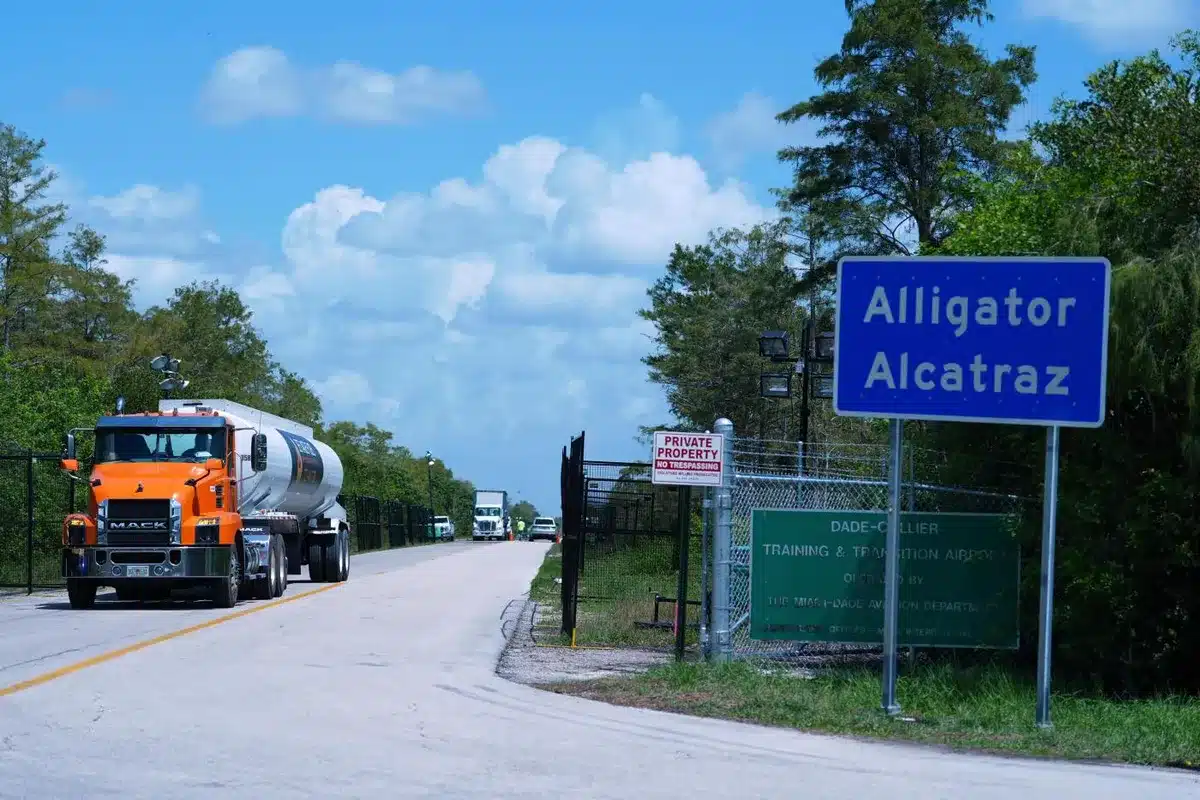
Federal attorneys are challenging a promised grant of more than $608 million to reimburse Florida for immigration enforcement expenses, leaving state taxpayers potentially liable for $573 million already spent.
Federal Backtracking on Grant Award
Attorneys from the U.S. Department of Justice argue in recent court filings that no final funding decision has been made by the Federal Emergency Management Agency (FEMA). They describe the state’s application as merely a preliminary step, with FEMA yet to approve the ultimate award.
“The existence of a state application is only a preliminary step towards a final federal funding decision, and FEMA has not made that ultimate decision even now,” the attorneys stated.
State’s Massive Immigration Spending
Florida has expended at least $573 million over the past three years on federal immigration duties. This includes building a temporary detention facility in the remote Florida Everglades, known as “Alligator Alcatraz,” constructed from tents and trailers at an isolated airstrip.
Gov. Ron DeSantis assured residents that federal reimbursement would cover these costs. In October 2025, he posted on social media celebrating the initial grant approval, stating, “We were right; media was wrong.”
State records show a Department of Homeland Security (DHS) grants administrator approved $608.4 million for the Fiscal Year 2025 Detention Support Grant Program, effective September 30, 2025.
Delays Attributed to Justice Department
Florida Division of Emergency Management (FDEM) Director Kevin Guthrie reports that federal officials amended the grant agreement after the initial notice and issued a final award in December 2025. However, he attributes the holdup to the Department of Justice.
“That reimbursement is right now held up by the Department of Justice,” Guthrie told reporters. “I can’t speak for the Department of Justice. I don’t know why they’re holding that up.”
Environmental Lawsuit Complicates Funding
The funding dispute arises amid a federal lawsuit by Friends of the Everglades and other groups. Plaintiffs claim officials violated environmental laws by skipping reviews before constructing the facility. A district judge ordered operations to cease, but an appeals court paused that ruling.
DOJ attorneys contend the site is state-managed without federal funds, exempting it from federal environmental rules. Environmental attorneys counter that DHS’s grant approval triggers those requirements.
“The fact is that just as the district court found, this facility required federal environmental review from the beginning because it’s an ICE detention center. No delay in disbursing federal funds affects that reality,” said Tania Galloni, an attorney for Earthjustice representing the plaintiffs.
Lawmakers Scrutinize Emergency Fund
The spending draws from a multi-billion-dollar Emergency Preparedness and Response Fund, created in 2022 for rapid crisis response. Lawmakers transferred $4.77 billion into it over four years, with FDEM spending beyond that via federal reimbursements.
An immigration-related emergency declaration, first issued January 6, 2023, and extended 20 times, enabled the Everglades project without legislative approval. Recent disclosures detail the fund’s use, prompting calls to reauthorize it before its February 17 expiration.
Republican state Sen. Ed Hooper, the Senate budget chair, expressed skepticism: “I don’t trust FEMA to do it. I hope they do what’s right.”
Democrats criticize the fund as a “slush fund” lacking oversight, diverted from schools, water projects, and infrastructure.
“How many schools are we unable to fund because it’s being spent on immigration enforcement?” asked Democratic state Sen. Carlos Guillermo Smith. “My reason for opposing the creation of this emergency response fund was because I feared that it would be abused… And I regret that many of those fears have become reality.”
Democratic state Sen. Tina Polsky added, “We have given up oversight… I am against the way this fund has been used and abused for a political issue.”
The Senate advanced reauthorization without new restrictions like bidding requirements or limits on declarations, while a House bill awaits debate.
