

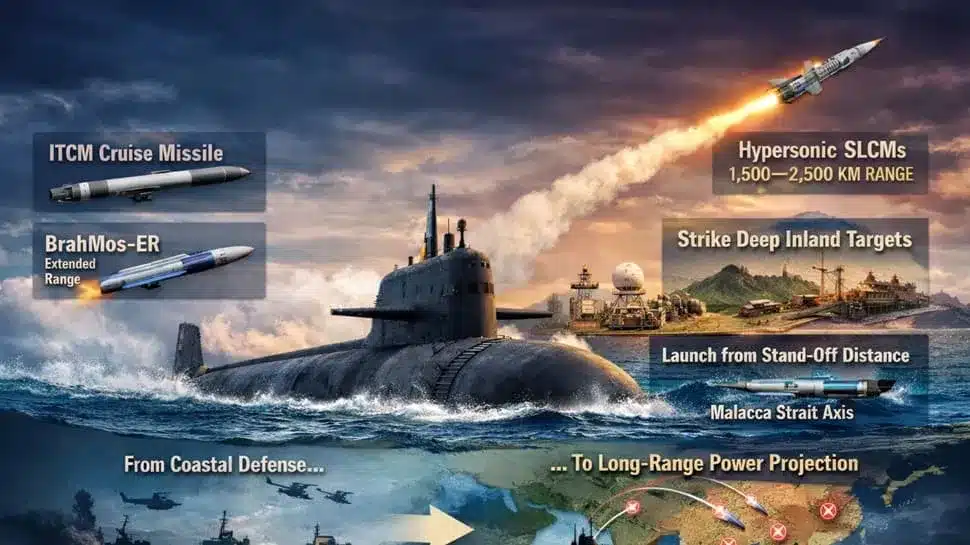
The Indian Navy strengthens its dominance in the Indian Ocean amid growing Chinese presence and threats from Pakistan. Project 77 marks a major evolution in undersea warfare, arming next-generation nuclear-powered attack submarines (SSNs) with advanced long-range strike capabilities, including hypersonic submarine-launched cruise missiles (SLCMs) reaching 1,500 to 2,500 km.
Understanding SSNs and Their Role
SSNs, or nuclear-powered attack submarines, excel in speed, stealth, anti-submarine warfare, surveillance, and surface ship attacks. Unlike ballistic missile submarines (SSBNs) focused on nuclear deterrence, SSNs now target land-based assets, adapting to Indo-Pacific challenges.
Key Missile Integrations
Project 77 submarines will deploy the Indigenous Technology Cruise Missile (ITCM), derived from the Nirbhay program, as a primary land-attack option. The extended-range BrahMos-ER variant will also feature, boosting reach against maritime and coastal targets for versatile conventional strikes.
Why Extended Range is Essential
Pakistan’s compact western front contrasts with China’s vast inland infrastructure, logistics hubs, and bases. Hypersonic SLCMs enable strikes from standoff distances, such as near the Malacca Strait, without nearing enemy coasts. This minimizes risks from anti-submarine networks and enhances flexibility.
Hypersonic Advantages
Speeds exceeding Mach 5 and low-altitude maneuvers make these missiles tough to intercept, slashing reaction times against advanced defenses. Benefits include:
- Improved survivability by avoiding monitored coastal areas.
- Added depth to conventional second-strike options alongside SSBNs.
- Transformation into offensive platforms for power projection.
Doctrinal Evolution
Project 77 transcends fleet growth, signaling a pivot from sea denial and coastal defense to layered deterrence and multi-theater strikes. These submarines evolve from stealth hunters to deep-strike deterrents, bolstering India’s strategic posture in the Indo-Pacific without aggressive deployments.
