

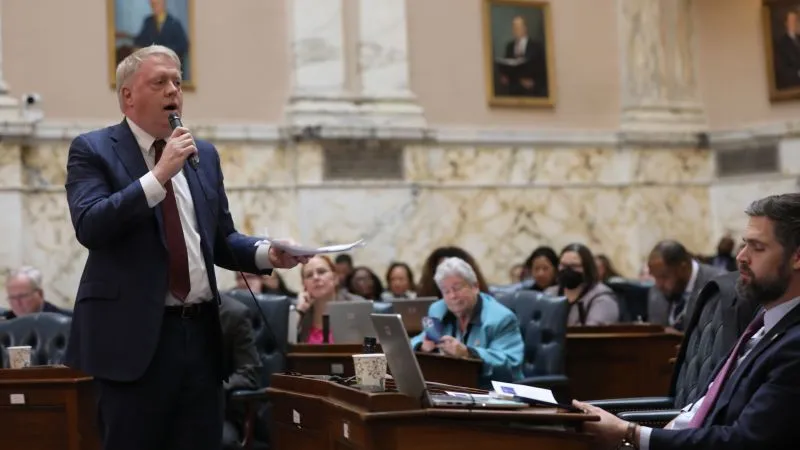
Controversial Congressional Map Advances in State Legislature
The Maryland House of Delegates approved a contentious congressional redistricting plan on Monday that seeks to reshape the state’s sole Republican-held U.S. House district. The proposal faces significant opposition in the state Senate, where leadership maintains it lacks sufficient support for passage.
Partisan Battle Over District Boundaries
The newly approved boundaries would substantially alter Maryland’s 1st Congressional District, currently represented by Republican Andy Harris. The redistricting proposal extends the Eastern Shore-based district across Chesapeake Bay to incorporate more Democratic-leaning areas. Democratic lawmakers argue the changes address previous partisan imbalances, while Republicans denounce the move as overt political maneuvering.
“This measure helps ensure proper congressional oversight of executive power,” stated Delegate C.T. Wilson, the bill’s primary sponsor, during floor debates. The four-hour discussion frequently referenced national redistricting efforts but avoided direct attribution to specific media outlets.
Senate Leadership Voices Constitutional Concerns
State Senate President Bill Ferguson has consistently opposed mid-decade redistricting, citing potential consequences for Democratic-held seats. Ferguson referenced Maryland’s recent redistricting history, noting that a 2021 congressional map was invalidated by courts for excessive partisan gerrymandering.
“Redrawing districts now invites renewed legal challenges that could ultimately place mapmaking authority in judicial hands,” Ferguson cautioned through a spokesperson. Legal experts suggest new boundaries could disrupt Maryland’s election calendar, with candidate filings due February 24 and primaries scheduled for June 23.
Historical Precedents and Political Calculations
Supporters of the new map note the 1st District has crossed Chesapeake Bay multiple times since the 1960s, including under court-ordered revisions. Delegate Marc Korman highlighted that five different Republicans won the seat under previous configurations, including current Representative Harris.
Republican leaders counter that the latest proposal represents unprecedented political targeting. “This purely partisan power grab disrespects Maryland voters,” charged House Minority Leader Jason Buckel during floor debates. The proposal arrives as multiple states engage in mid-decade redistricting efforts following recent Supreme Court decisions.
Maryland’s congressional delegation currently consists of seven Democrats and one Republican. The redistricting proposal requires Senate approval before advancing to the governor’s desk.
