

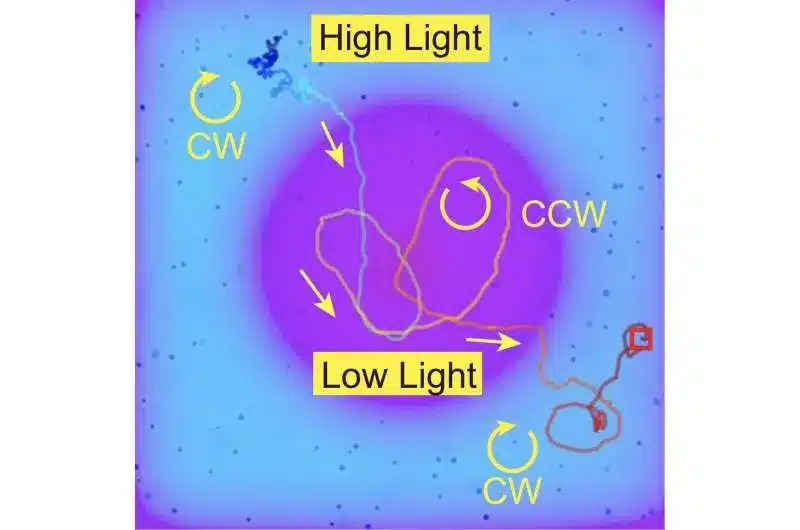
Researchers from the University of Hong Kong and the UK demonstrate how self-propelling microbes adjust their swimming paths based on light levels. A team led by Zhao Wang at the University of Hong Kong reveals that these microbes alter flagella beating patterns to maximize light intake for photosynthesis. The study appears in ical Review Letters.
Microbial Propulsion Techniques
Microbes navigate by rhythmically beating flagella, hair-like structures. Strategies vary: some bacteria alternate straight runs with sudden tumbles, while others curve paths in response to chemical signals. Many switch modes according to environmental cues, but the underlying bioical triggers remained unclear.
Tracking Individual Algae Cells
Earlier work by Kirsty Wan and Dario Cortese at the University of Exeter analyzed the green alga Chlamydomonas reinhardtii. This single-celled organism swims using two flagella in a synchronized breaststroke. Three-dimensional tracking shows helical trajectories that bend toward light sources through changes in flagella frequency, amplitude, and synchronization.
Light-Driven Path Changes
Wang’s group, including Wan, used high-speed imaging to examine flagella beats under different light intensities. They studied free-swimming cells and those secured at micropipette tips for precise measurements.
Under low light, cells trace counterclockwise circles as the flagellum nearer the eyespot beats stronger, dominating propulsion. Beyond a specific intensity threshold, a phase shift between flagella reorients the beating plane, switching to clockwise paths that direct cells toward brighter light.
Evolutionary Benefits and Tech Potential
This switch enables Chlamydomonas reinhardtii to fine-tune light exposure, enhancing photosynthesis efficiency by avoiding suboptimal conditions.
The mechanism could guide development of advanced microswimmers. Such robots might navigate confined spaces with precise control, enabling applications like targeted drug delivery inside the body.
Zhao Wang et al, Light-Dependent Switching of Circling Handedness in Microswimmer Navigation, ical Review Letters (2026). DOI: 10.1103/6cdq-1nvv. Preprint on bioRxiv: DOI: 10.1101/2025.08.08.669292
