

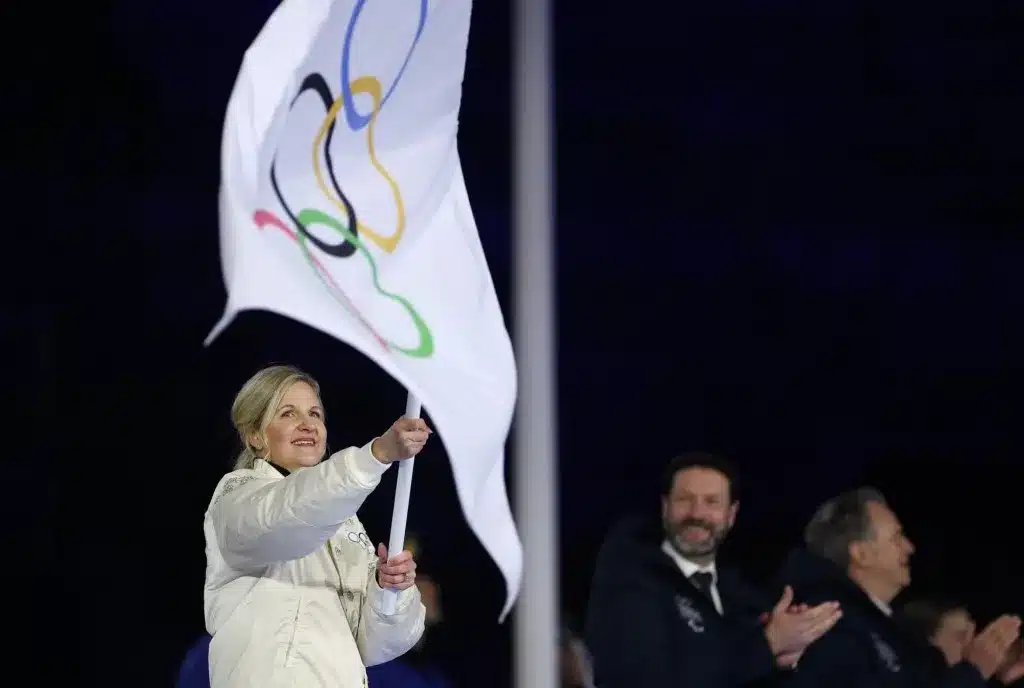
The Milano Cortina 2026 Winter Olympics concluded with a vibrant closing ceremony at the historic Arena di Verona on February 22, 2026. This ancient amphitheater, constructed in the 1st century, has endured empires, natural disasters, and wars, once hosting gladiatorial combats and even serving as a refuge during the Siege of Verona in 312 A.D.
Reflections on Unity and Division
Giovanni Malago, president of Milano Cortina 2026, described the Games as “an extraordinary kaleidoscope of sporting achievements and personal journeys, where passions and emotions come together, alongside some of the contradictions of our deeply divided world.”
Heartwarming moments shone through, including U.S. figure skater Ilia Malinin congratulating Kazakhstan’s gold medalist Mikhail Shaidorov with, “You deserved this victory!” American snowboarder Chloe Kim shared an embrace with South Korea’s Choi Gaon after the teen’s upset victory. Fresh gold medalist Alysa Liu celebrated with Japan’s bronze winner Ami Nakai, exclaiming, “Let’s celebrate!”
IOC President Kirsty Coventry called the event “truly magical,” yet the Games mirrored global tensions, amplifying athletes’ visibility amid geopolitical strains.
Political Tensions Surface
Athletes faced U.S. political crosscurrents. Freestyle skier Hunter Hess voiced “mixed emotions” about representing the U.S. under current policies. Vice President J.D. Vance, attending early events with Secretary of State Marco Rubio, urged athletes to focus on sport, warning, “You’re there to play a sport, and you’re there to represent your country and hopefully win a medal. You’re not there to pop off about politics.” He added that outspoken athletes should “expect some pushback.”
Vance drew boos during the opening ceremony broadcast. Evita Duffy-Alfonso, daughter of Transportation Secretary Sean Duffy, suggested vetting Olympians for patriotism. Figure skater Amber Glenn, the first openly queer U.S. woman in the sport, reported receiving “a scary amount of hate / threats for simply using my voice WHEN ASKED about how I feel.”
Stunning Venues and Hosting Realities
Milan showcased breathtaking scenery from its Duomo to the Alps and Dolomites, rivaling Vancouver 2010 for Winter Olympic beauty. Organizers spread events across 8,495 square miles in four clusters and six villages—the largest footprint ever—emphasizing existing venues amid climate concerns.
Japan’s chef de mission Hidehito To noted travel challenges: “Moving around the venues took quite a lot of time… It took about eight or nine hours.” Volunteers showed enthusiasm but often lacked key information. Local residents tolerated the event with minimal fanfare, while international supporters—Canadians at hockey, Dutch speed skating fans, and U.S./Japanese figure skating crowds—infused energy.
Alysa Liu captured the vibe: “An unbelievable feeling was just when I was skating… I felt so connected with this audience. I want to be out there again.”
Record Medal Hauls
Norway topped the medal table for the third straight Winter Games with 41 medals, including a record 18 golds. Cross-country skier Johannes Hoesflot Klaebo swept all six events, surpassing Eric Heiden’s five-gold mark from 1980. Teammate Martin Loewstroem praised, “What is the most impressive about him is how complete he is… There aren’t that many people who win 100m and 10,000m.”
The U.S. secured second place with 33 medals and 12 golds—its best total and gold count since 1952 Oslo, breaking the 2002 Salt Lake record. Team USA swept ice hockey, with men claiming first gold since the 1980 “Miracle On Ice.” Speed skater Jordan Stolz took two golds, and Alysa Liu ended a 24-year U.S. women’s figure skating drought. After retiring post-Beijing 2022, Liu returned triumphantly.
Coventry closed with, “This is the true Olympic spirit: competing, embracing, lifting each other up, whatever the result… You showed us what excellence, respect, and friendship look like in a world that sometimes forgets these values.”
