

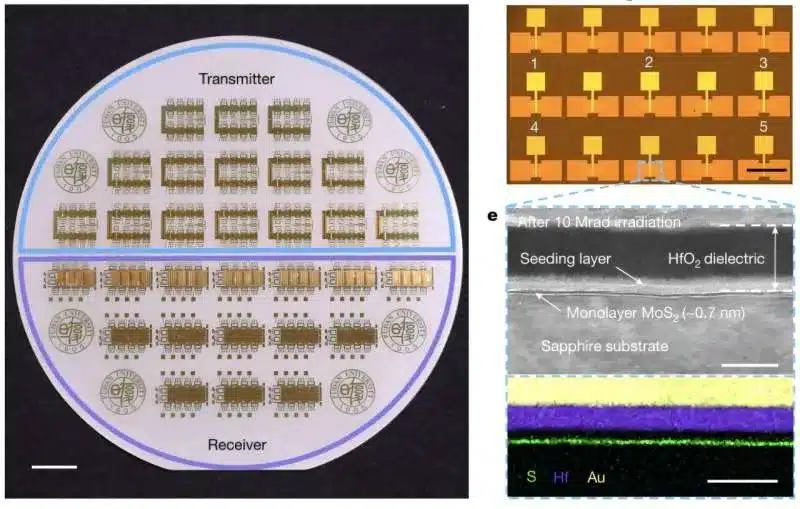
Researchers at Fudan University demonstrate that atom-thick layers of molybdenum disulfide (MoS2) excel in radiation-resistant spacecraft electronics. Their study, published in Nature, subjects a MoS2-based communications system to extreme tests, including gamma ray exposure and nine months in low-Earth orbit, revealing minimal performance degradation.
Challenges of Space Radiation
Beyond Earth’s magnetic field, spacecraft electronics face relentless cosmic rays and heavy ions. Traditional shielding adds weight and launch costs, reducing payload for instruments. Intrinsically radiation-hardened materials like monolayer MoS2—measuring just 0.7 nanometers thick—offer a superior alternative, as prior lab tests confirm their resistance to defects.
Rigorous Laboratory Testing
Peng Zhou and team fabricate a transistor-based radio-frequency system using grown monolayer MoS2. They expose circuits to gamma ray doses mimicking space conditions. Advanced techniques assess damage: transmission electron microscopy images cross-sections, energy-dispersive spectroscopy maps chemical changes, and Raman spectroscopy checks structural integrity across the film.
Results show no detectable structural or chemical alterations. Electrical tests confirm unchanged performance, including ultra-high on-off ratios, minimal leakage current, and low power use—crucial for energy-constrained missions.
Real-World Orbit Validation
The team launches the system to 500 kilometers altitude, matching many communications satellites. Over nine months, it transmits data with extremely low error rates. At experiment’s end, the device flawlessly handles the full Fudan University Anthem.
Long-Term Potential
Projections indicate MoS2 electronics could endure 271 years in geosynchronous orbit, surpassing silicon-based systems. This tolerance promises lighter, durable components for deep-space missions and orbital communications.
