

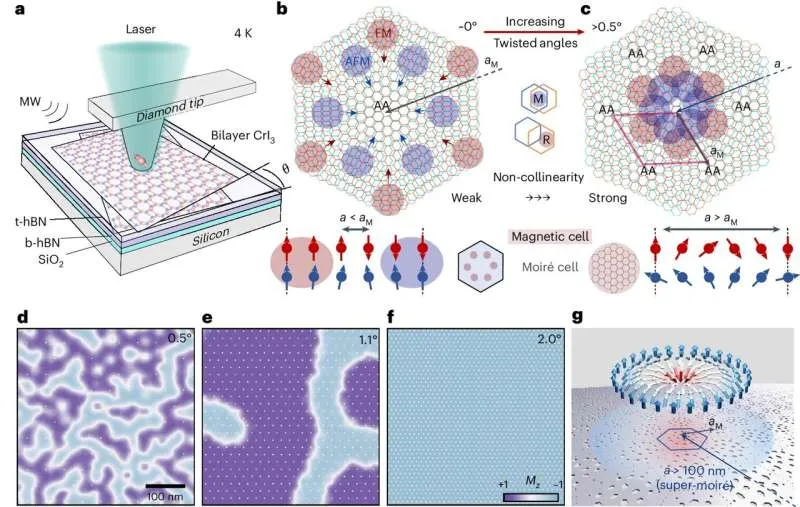
Researchers have experimentally confirmed a novel type of magnetism in atomically thin layers of chromium iodide, opening doors to advanced magnetic data storage and deepening insights into 2D magnetic interactions.
Breakthrough in Magnetic States
A team led by Professor Jörg Wrachtrup, Head of the Center for Applied Quantum Technologies at the University of Stuttgart, identified this unique magnetic state in a structure of four atomic layers. The discovery appears in Nature Nanotechnology.
“As data volumes explode, future magnetic storage must handle higher densities reliably,” Wrachtrup states. “These findings directly support next-generation technologies while revealing key details about magnetism in atom-thin materials.”
Controlling Magnetism Through Layer Interactions
Dr. Ruoming Peng, a postdoctoral researcher at the University of Stuttgart’s 3rd ics Institute, conducted key experiments alongside doctoral researcher King Cho Wong. “We precisely tune this magnetism by adjusting electron interactions across layers,” Peng explains. “Remarkably, these properties resist environmental disruptions effectively.”
Chromium iodide, a 2D material with a crystalline lattice of few atomic layers, shows behaviors distinct from its 3D bulk form. Twisting two bilayers relative to each other generates this new state, producing skyrmions—stable, nanoscale magnetic structures ideal for data carriers.
“Untwisted bilayers produce no net external field, unlike this twisted configuration,” Peng notes. This marks the first creation and direct observation of skyrmions in twisted 2D magnets.
Advanced Quantum Sensing Techniques
Detecting these faint signals required a specialized quantum sensing microscope using nitrogen-vacancy centers in diamond, refined over two decades at the Center for Applied Quantum Technologies.
Advancing Theoretical Models
The results challenge current theories on electron behavior in thin magnetic systems. “Experiments show that existing models require updates to explain these observations,” Wrachtrup adds.
King Cho Wong et al., Super-moiré spin textures in twisted two-dimensional antiferromagnets, Nature Nanotechnology (2026). DOI: 10.1038/s41565-025-02103-y
