
Close Menu
VernoNews
  • Home
  • World
  • National
  • Science
  • Business
  • Health
  • Education
  • Lifestyle
  • Entertainment
  • Sports
  • Technology
  • Gossip
Trending

Satellite Images Reveal Iran Fortifying Nuclear Sites and Missile Bases

February 20, 2026

Planthopper Bacteria Shatter Record for Smallest Genome Ever

February 20, 2026

Toronto Police Warn: Stay Off Thin Ice on Lakes After Close Calls

February 20, 2026

Atom-Thin MoS2 Electronics Resist Space Radiation for Centuries

February 20, 2026

NHAI Bans Cash Tolls: FASTag or UPI Mandatory from April 2026

February 20, 2026

J-K Forces Foil Six IED Terror Plots Since January 2026

February 20, 2026

Shapewear Booms in India: Breathable Designs Reshape Fashion

February 20, 2026
Facebook X (Twitter) Instagram
VernoNews
  • Home
  • World
  • National
  • Science
  • Business
  • Health
  • Education
  • Lifestyle
  • Entertainment
  • Sports
  • Technology
  • Gossip
VernoNews
Home»Science»Planthopper Bacteria Shatter Record for Smallest Genome Ever
Science

Planthopper Bacteria Shatter Record for Smallest Genome Ever

VernoNewsBy VernoNewsFebruary 20, 2026No Comments3 Mins Read
Facebook Twitter Pinterest LinkedIn Tumblr Reddit WhatsApp Email
Planthopper Bacteria Shatter Record for Smallest Genome Ever
Share
Facebook Twitter LinkedIn Pinterest WhatsApp Email

Many insects depend on heritable bacterial endosymbionts to supply essential nutrients missing from their diets. A recent study reveals that genomes of these symbiotic bacteria shrink dramatically over time, with some in planthoppers setting a new record for the smallest non-organelle genome discovered.

Essential Role of Endosymbionts in Sap-Feeding Insects

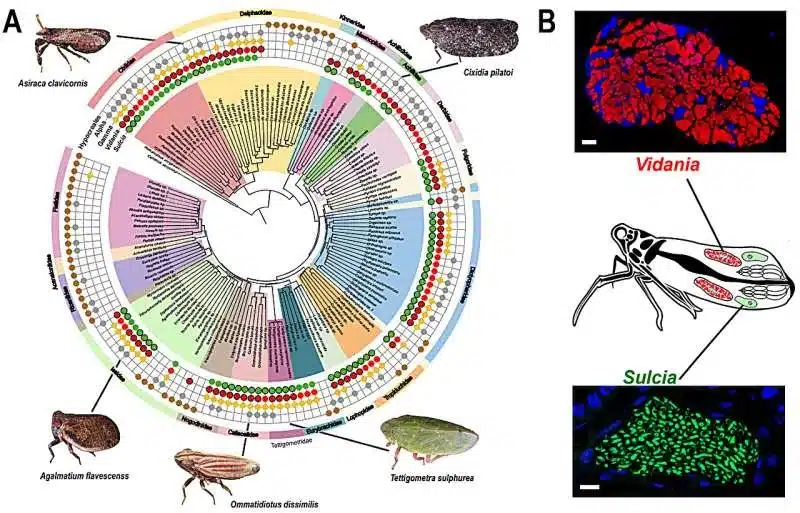
Sap-sucking insects like planthoppers and cicadas rely on endosymbiotic bacteria for survival. Plant sap lacks key amino acids and vitamins, so these insects have co-evolved over hundreds of millions of years with bacteria that provide them. Sulcia and Vidania, two such endosymbionts, have partnered with planthoppers for over 260 million years, residing in specialized abdominal cells.

Record-Shattering Genome Sizes

Researchers sequenced and compared 131 complete symbiont genomes—63 Sulcia and 67 Vidania—from 149 planthopper species. Sulcia genomes range from 137,729 to 180,379 base pairs (bp), while Vidania genomes span 50,141 to 136,554 bp. Several Vidania genomes eclipse prior records, including Nasuia in leafhoppers (at least 107.8 kb), earlier Vidania strains (at least 108.6 kb), and Tremblaya in mealybugs (at least 139 kb).

Researchers note, “The reconstructed Sulcia genomes ranged in size from 137,729 bp to 180,379 bp, and Vidania ranged from 50,141 bp to 136,554 bp.”

Minimal Genes for Host Survival

These ultra-compact genomes retain only essential genes, primarily for synthesizing phenylalanine, a critical amino acid for the host. Loss of genes tied to other cellular functions renders the bacteria heavily reliant on their insect hosts, resembling organelles.

Convergent Evolution Across Lineages

Two planthopper superfamilies show convergent evolution, with Vidania strains VFSACSP1 (50,141 bp) and VFMALBOS (52,460 bp) developing independently. Genetic analysis confirms both encode phenylalanine biosynthesis pathways, while losing those for six other amino acids.

The researchers state, “Notably, the extremely reduced state represented by these two genomes has evolved independently in two superfamilies separated by ~263 million years of evolution. Despite their independent origins, these genomes exhibit striking similarity in gene retention patterns and organization compared to their common ancestor, which must have had a genome approximately three times their size.”

Factors Driving Genome Reduction

Evolutionary pressures explain the shrinkage, including strong mutation and deletion rates, lack of recombination, no gene acquisition opportunities, and genetic drift from transmission bottlenecks. Non-essential genes erode gradually, per population-genetic theory like Muller’s ratchet.

Further reductions occur when hosts gain complementary symbionts, face ecological shifts, or integrate functions themselves. While Vidania holds the current smallest bacterial genome record, more discoveries in other insects may follow. These findings illuminate organelle evolution, such as mitochondria, and cellular life’s limits.

Study: Anna Michalik et al, “Convergent extreme reductive evolution in ancient planthopper symbioses,” Nature Communications (2026). DOI: 10.1038/s41467-026-69238-x

Avatar photo
VernoNews

    Related Posts

    Atom-Thin MoS2 Electronics Resist Space Radiation for Centuries

    February 20, 2026

    Global Study: Smaller Fish Reshape Food Webs Amid Stable Species

    February 19, 2026

    Hanmi Pharm Starts Phase 2 Dosing for NRAS Melanoma Drug

    February 19, 2026

    Comments are closed.

    Don't Miss
    top

    Satellite Images Reveal Iran Fortifying Nuclear Sites and Missile Bases

    By VernoNewsFebruary 20, 20260

    Recent satellite imagery highlights Iran’s intensified military preparations amid escalating tensions with the United States.…

    Planthopper Bacteria Shatter Record for Smallest Genome Ever

    February 20, 2026

    Toronto Police Warn: Stay Off Thin Ice on Lakes After Close Calls

    February 20, 2026

    Atom-Thin MoS2 Electronics Resist Space Radiation for Centuries

    February 20, 2026

    NHAI Bans Cash Tolls: FASTag or UPI Mandatory from April 2026

    February 20, 2026

    J-K Forces Foil Six IED Terror Plots Since January 2026

    February 20, 2026

    Shapewear Booms in India: Breathable Designs Reshape Fashion

    February 20, 2026
    About Us
    About Us

    VernoNews delivers fast, fearless coverage of the stories that matter — from breaking news and politics to pop culture and tech. Stay informed, stay sharp, stay ahead with VernoNews.

    Our Picks

    Satellite Images Reveal Iran Fortifying Nuclear Sites and Missile Bases

    February 20, 2026

    Planthopper Bacteria Shatter Record for Smallest Genome Ever

    February 20, 2026

    Toronto Police Warn: Stay Off Thin Ice on Lakes After Close Calls

    February 20, 2026
    Trending

    Atom-Thin MoS2 Electronics Resist Space Radiation for Centuries

    February 20, 2026

    NHAI Bans Cash Tolls: FASTag or UPI Mandatory from April 2026

    February 20, 2026

    J-K Forces Foil Six IED Terror Plots Since January 2026

    February 20, 2026
    • Contact Us
    • Privacy Policy
    • Terms of Service
    2025 Copyright © VernoNews. All rights reserved

    Type above and press Enter to search. Press Esc to cancel.