

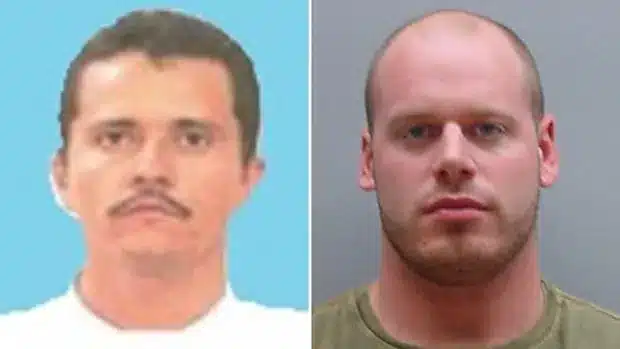
Ontario native and alleged cocaine kingpin Ryan Wedding had no involvement in the operation that resulted in the death of cartel leader Nemesio Oseguera Cervantes, known as El Mencho, his lawyer maintains.
The Mexican military eliminated the powerful drug lord on Sunday, precisely one month after authorities took Wedding into custody in Mexico and transferred him to the United States. Online speculation suggested a possible connection between the events, but Wedding’s California-based attorney, Anthony Colombo, stated unequivocally, “there is zero connection between Mr. Wedding and the action yesterday.”
Wedding’s Criminal Operations
A former Olympic snowboarder from Thunder Bay, Ontario, Wedding, 44, oversaw a violent drug-smuggling network that transported 60 tonnes of cocaine across North America annually, U.S. authorities report. Arrested in Mexico in January, he was quickly flown to California, where he entered a not guilty plea to charges of murder and drug trafficking.
Mexican officials clarified that they tracked Oseguera using a tip from an associate of one of his romantic partners, supported by U.S. intelligence. Both men ranked as high-value targets, with U.S. rewards of $15 million offered for information leading to their capture.
Unlike Oseguera, a cartel boss, Wedding operated as a major logistics provider, managing sophisticated smuggling routes over thousands of kilometers. The FBI noted his long-term protection from the Sinaloa cartel, founded by Joaquín “El Chapo” Guzmán. While no direct ties to Oseguera’s Jalisco New Generation Cartel (CJNG) were publicly confirmed, evidence suggests occasional collaboration between their networks.
Key Associates and Investigations
Wedding’s top deputy, Canadian Andrew Clark, was detained by Mexican forces in October 2024. Mexico’s security minister, Omar García Harfuch, revealed Clark managed logistics for both Sinaloa and CJNG. Clark later became an FBI informant, aiding the probe into Wedding’s organization.
U.S. officials describe Wedding as Canada’s dominant cocaine importer. His network may connect to a massive Toronto seizure under Project Castillo, where police recovered 835 kilograms valued at $83 million, earmarked for nationwide distribution.
Toronto-based crime analyst Luis Nájera, originally from Mexico, warns such busts often trigger CJNG reprisals. “When this kind of seizure happens, there’s people who have to pay for that,” he explained. “And usually payment is basically, your life.”
Potential Impact on Cocaine Prices
Police in major Canadian cities anticipate price surges in bulk cocaine following Oseguera’s death. Investigators in Toronto and Montreal monitor shifts in the illicit market.
In Montreal, kilogram prices hit $33,000 briefly after Wedding’s arrest before settling at $21,000, within normal ranges, according to a police spokesperson. Toronto prices currently range from $21,000 to $26,000, but spokesperson Ashley Visser expects an uptick due to Mexican developments.
Montreal spokesperson Samantha Velandia noted that price swings affect product quality: “fluctuations in the price of a kilo influence the quality of the product, which tends to be purer when the price is low” and adulterated when prices rise. User-level prices remain stable, but risks increase.
Federal Public Safety Minister Gary Anandasangaree emphasized the significance: “any type of reduction in the capacity of transnational organized crime networks to be able to do their trade is important.” He cautioned, however, that effects may prove temporary.
