

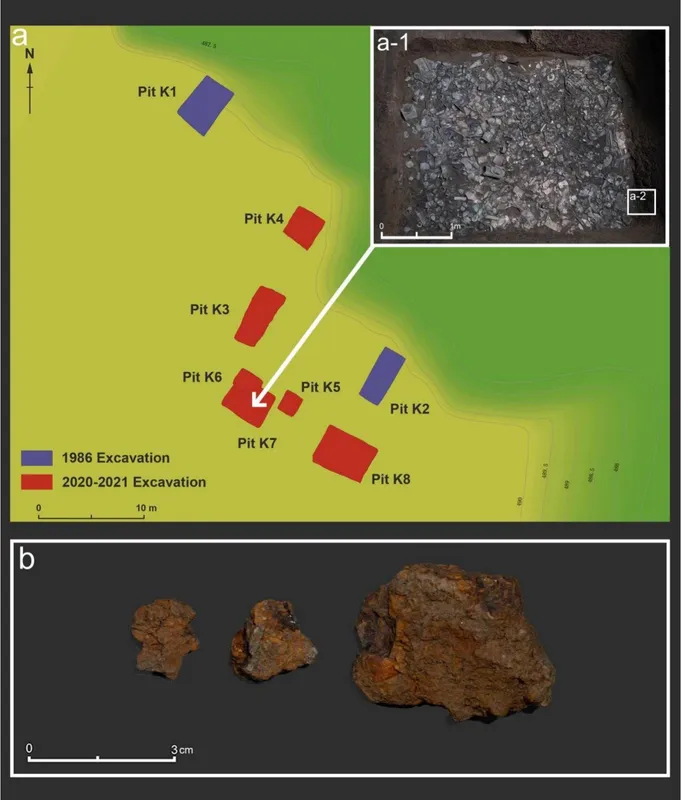
Researchers have identified China’s earliest known Bronze Age meteoritic iron artifact at the Sanxingdui sacrificial site in southwestern China. This axe-shaped tool, the largest of its kind discovered in the country, offers new insights into ancient metallurgical techniques during the Shang Dynasty.
The Sanxingdui Site
Situated in Guanghan, Sichuan Province, Sanxingdui ranks among China’s top archaeological discoveries of 2021. Dating from 2800 to 600 BCE, this expansive Shang Dynasty city (1600–1046 BCE) stands as the largest urban center in southern China. It features sophisticated urban layouts with craft areas, palaces, and ritual pits containing remarkable bronze masks, trees, and figurines.
The artifact, labeled K7QW-TIE-1, emerged from Pit No. 7 alongside other ritual items.
Artifact Description
Measuring 20.05 cm long and 5.27–7.90 cm wide, the fragile axe-like tool or weapon consists of three fragments. Analysis via metallography and scanning electron microscopy with energy dispersive spectroscopy (SEM-EDS) shows minimal cold-working, characteristic of iron use before widespread smelting in China.
Its uniform nickel-iron composition proves challenging for Late Shang smelting methods, confirming meteoritic origins. The precise meteorite type awaits further study.
Expert Insights on Origin
Dr. Zishu Yang, a key researcher, notes, “While the SEM-EDS results provide preliminary insights, they are insufficient to definitively classify the specific type of meteorite. The precise classification, therefore, remains unresolved. In the next stage of research, we plan to employ more advanced analytical techniques to further constrain its origin and evaluate possible correspondences with known meteorite falls in the region.”
Comparison with Other Finds
China records only 13 meteoritic iron artifacts, mainly from northern areas like Henan, Hebei, and Beijing, with fewer in Hubei and Sichuan. The oldest, a knife from Xinjiang’s Narensu cemetery around 3000 BCE, shares monometallic traits with the Sanxingdui piece.
Northern examples typically feature meteoritic iron as inserts in bronze-iron tools from elite burials, highlighting distinct southwestern practices.
Ritual vs. Practical Role
All known meteoritic artifacts serve as tools or weapons. At Sanxingdui, its sacrificial pit context suggests ritual importance over utility. Dr. Yang explains, “In the broader context of ancient China, we believe cultural and practical considerations likely coexisted. Early metal was scarce and imbued with sacred significance; after large-scale production, its use became increasingly pragmatic. Due to the extreme rarity of meteoritic iron artifacts, it remains difficult to determine which factor predominated nationwide.”
“However, for the specific specimen examined here, we argue that its ritual significance likely outweighed its utilitarian value. This interpretation is supported by its discovery in the Sanxingdui sacrificial area, where the vast majority of associated finds are generally interpreted as objects used in ceremonial contexts.”
Upcoming Research
Future efforts will refine meteorite identification and integrate the artifact into ongoing Pit No. 7 excavations. Dr. Yang adds, “In addition to refining the metallurgical identification of the meteorite, our future work will focus on recontextualizing the artifact within its archaeological context. As excavation and research at Sanxingdui Pit No. 7 continue to advance, we expect to obtain a more comprehensive understanding of this meteoritic iron object and its significance within the broader site context.”
