

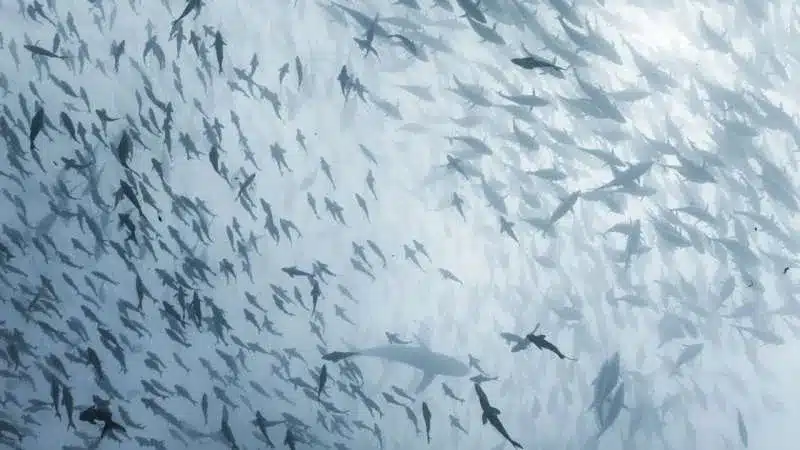
Scientists analyzing long-term data from nearly 15,000 marine and freshwater fish communities worldwide reveal substantial shifts in fish food webs over recent decades. These changes persist even in ecosystems where species richness remains stable, according to a new study published in Science Advances.
Decline in Large Predators, Rise of Smaller Species
Researchers combined time-series data spanning up to 70 years with details on fish body sizes, diets, and trophic positions. While overall species richness shows no clear trend, species composition undergoes strong shifts. Communities increasingly feature smaller-bodied fish across diverse ecosystems.
“We often say ‘big fish eat small fish,’ and in nature it’s true—it’s an ecological rule,” states Dr. Juan Carvajal-Quintero, lead author and Assistant Professor at Dalhousie University. “Fish predators are usually larger than their prey, and this size difference determines who can eat whom. When the size of predators or prey changes, feeding relationships shift, reshaping food webs and how ecosystems function.”
Denser Connections and Generalist Feeders
Food webs grow more densely connected as species interact with a wider range of prey. This trend signals a rise in generalist feeders with less specialized diets. Large top predators, such as sharks, goliath groupers, muskellunge, and marble trout, decline in proportion, while mid-level predators and primary consumers increase. These dynamics alter species distribution across trophic levels.
“Together, these results indicate a widespread reorganization of fish food webs, affecting both their structure and function,” notes Prof. Ulrich Brose, head of a research group at Friedrich Schiller University Jena. “Increased connectance may accelerate the spread of perturbations among species, yet it may also enhance overall buffering capacity against disturbances such as warming, eutrophication, or fishing pressure. As a result, the responses of future food webs to global change remain highly uncertain.”
Worldwide Patterns Signal Broad Reorganization
Similar patterns emerge in both marine and freshwater systems across multiple global regions, pointing to long-term restructuring rather than localized effects. Food-web structure influences how pressures like warming, overfishing, and nutrient loading propagate through ecosystems. The loss of top predators and dominance of generalists with overlapping diets amplify these ripples.
“No single study could reveal this,” says senior author Prof. Jonathan Chase, head of a research group at Martin Luther University Halle-Wittenberg. “It’s only by synthesizing nearly 15,000 fish communities spanning decades and linking compositional changes to food-web theory that we can see how consistent and widespread this restructuring really is.”
The findings underscore that tracking species richness alone overlooks key biodiversity shifts. Monitoring traits like body size and interactions offers deeper insights into ecosystem dynamics, aiding conservation strategies.
Reference: Juan D. Carvajal-Quintero et al, Degradation of fish food webs in the Anthropocene, Science Advances (2026). DOI: 10.1126/sciadv.adu6540
