

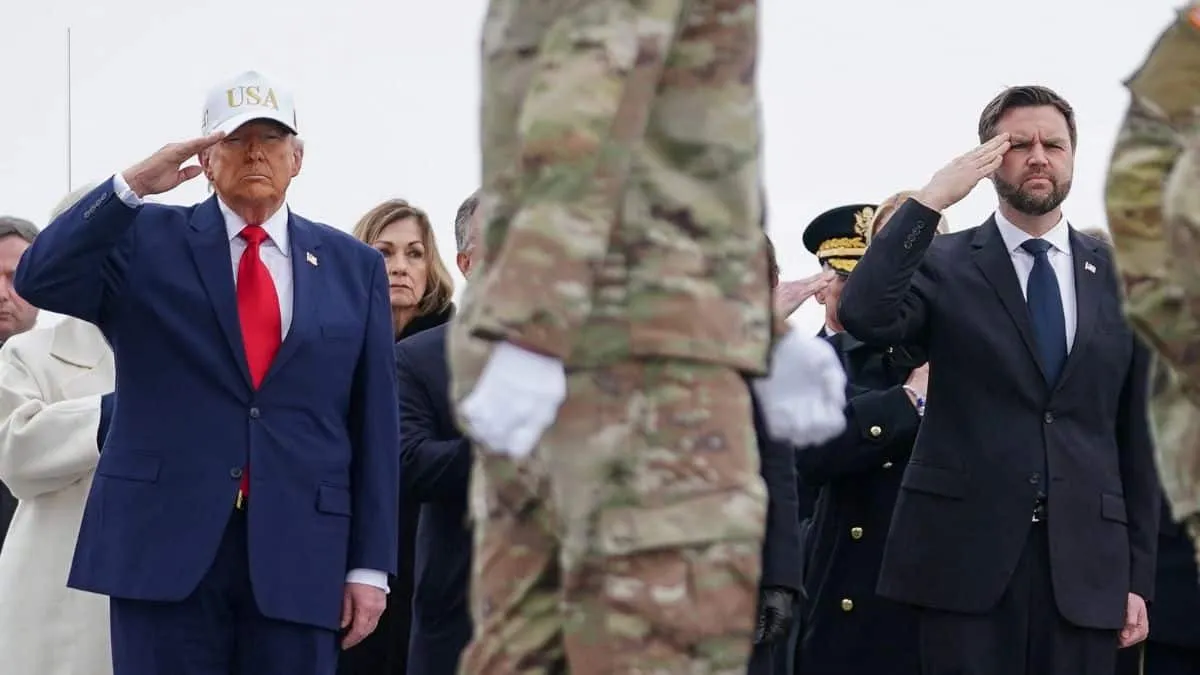
President Donald Trump stated on Thursday that he has no intention of deploying U.S. troops to West Asia. Responding to a question about sending additional service members to the region, Trump remarked, “I’m not putting troops anywhere. If I were, I certainly wouldn’t tell you. But I’m not putting troops. We will do whatever is necessary.”
This comes amid ongoing U.S. military operations against Iran, launched on February 28, which primarily utilize airpower and naval assets to target Tehran’s military infrastructure. U.S. Central Command reports over 7,800 strikes on Iran’s naval fleet, missile reserves, drone capabilities, and defense facilities, resulting in the damage or destruction of more than 120 Iranian vessels.
The U.S. maintains about 50,000 troops across regional bases. While standoff weapons dominate the campaign, officials evaluate options like ground forces to enhance flexibility against changing conditions. A White House official noted anonymously, “There has been no decision to send ground troops at this time, but President Trump wisely keeps all options at his disposal.” The official added, “The president is focused on achieving all of the defined objectives of Operation Epic Fury: destroy Iran’s ballistic missile capacity, annihilate their navy, ensure their terrorist proxies cannot destabilize the region, and guarantee that Iran can never possess a nuclear weapon.”
Potential Objectives for U.S. Ground Forces
Key targets include the Strait of Hormuz, a vital chokepoint for global oil shipments. Plans emphasize securing shipping lanes, possibly with forces along Iran’s coastline to counter threats. Another priority is Kharg Island, handling 90% of Iran’s oil exports. Strikes have hit the island, but experts suggest physical control could more effectively disrupt Tehran’s economy, despite risks from missiles and drones.
U.S. planners also consider Iran’s nuclear program, including securing enriched uranium stockpiles. Assessments indicate strikes have damaged key facilities, but discussions continue on safeguarding materials.
Shape of a Possible Ground Operation
Any deployment would likely involve limited, specialized missions rather than large invasions, given Iran’s vast size and terrain. Thomas Bonnie James, a professor at Qatar’s AFG College with The University of Aberdeen, explained, “It is far more likely to refer to limited, specialised operations involving small units targeting specific facilities, potentially supported by rapid-deployment forces, such as the 82nd Airborne Division.”
Elite units like Navy SEALs and Army Special Forces would handle sensitive tasks at sites such as Natanz, Fordow, and Isfahan. Operations would prioritize air superiority before rapid insertion and withdrawal.
Risks and Current Posture
The conflict has already claimed 13 U.S. lives and injured around 200 service members, mostly minor wounds. Ground troops would amplify threats from missiles, drones, and guerrilla attacks, potentially escalating to conventional war.
The U.S. prepares an Amphibious Ready Group with a Marine Expeditionary Unit of over 2,000 Marines, though the USS Gerald R. Ford’s maintenance in Greece limits some assets.
American Public Opinion
Polls show strong opposition to ground operations in Iran, with majorities against, including among Republicans who favor strikes but not troop commitments. U.S. Ambassador to the United Nations Mike Waltz assured, “This isn’t going to be another 2003 Iraq. There are not going to be hundreds of thousands of troops occupying urban areas somewhere.” He emphasized readiness: “The military is preparing options to ensure that forces are trained, equipped, in position and ready for whatever he chooses to do as commander in chief.”
