

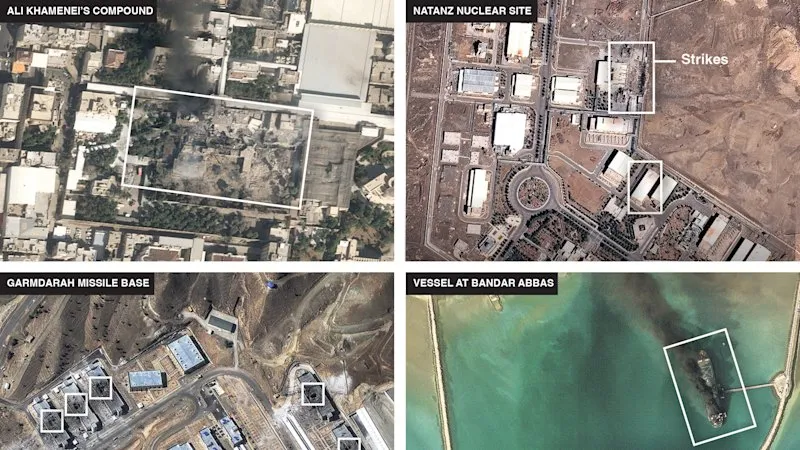
March 8, 2026 – One week into the conflict with Iran, the United States and Israel have launched strikes on approximately 4,000 targets across land, air, and sea domains. This intense bombing campaign marks one of the most aggressive U.S. military operations in recent decades, aiming to dismantle Iran’s repressive security apparatus, neutralize its missile capabilities, cripple its navy, and halt nuclear weapons development.
Strategic Objectives
U.S. President Donald Trump declared on Friday (Washington time) that operations will persist until Iran’s unconditional surrender, signaling a prolonged engagement. Despite the loss of Iran’s supreme leader Ayatollah Ali Khamenei and several top officials, the Islamist regime established in 1979 endures. Iranian forces continue launching missiles and drones toward Israel and regions hosting U.S. troops, while vast security networks remain operational.
Leadership and Command Disruptions
In the war’s opening moments, Israeli warplanes unleashed missiles on a leadership compound in central Tehran, where senior national security officials convened. Ayatollah Khamenei perished in a nearby building during the assault last weekend. Israel subsequently eliminated Iran’s top commander overseeing Lebanon operations, striking him in Tehran.
President Trump noted that multiple potential successors to Khamenei have been killed, expressing intent to influence the selection of Iran’s next leader. Ongoing efforts target additional high-profile Iranian officials deemed threats.
Security and Intelligence Targets
Strikes focus on Iran’s security and intelligence agencies, including the powerful Revolutionary Guard, its Basij militia, and the Quds Force handling foreign operations. Israeli forces deployed dozens of warplanes to demolish a key compound in eastern Tehran serving as headquarters for these units. Estimates indicate hundreds of Basij and Guard members killed, alongside thousands of other security personnel.
The Pentagon confirmed bombings on Guard-linked sites, citing decades of attacks on Americans by the Guard and its proxies. Detention centers and broadcasting facilities also faced hits to undermine regime control and information dissemination.
Achieving Air and Naval Superiority
Central to the campaign, assaults on air defenses, missile depots, launchers, and bases have secured air dominance. The Israeli military reports over 300 missile launchers and 150 air defense systems neutralized, with continued operations against ballistic missiles and launch sites.
U.S. forces have devastated Iran’s navy, sinking 30 vessels including a submarine. A U.S. submarine fired a torpedo to sink an Iranian warship in the Indian Ocean and targeted a drone carrier. These actions aim to diminish threats to shipping in the Strait of Hormuz, vital for one-fifth of global oil and significant natural gas exports.
Nuclear Program Disruptions
Preventing nuclear armament remains a priority. In June, joint U.S.-Israeli strikes, described by President Trump as having “destroyed” Iran’s nuclear potential, resumed with fresh attacks. The Natanz facility—core to uranium enrichment—suffered major damage, with satellite imagery revealing destroyed entrances to an underground centrifuge cavern.
Damage assessments for Isfahan and Fordow, hit during the prior 12-day Israel-Iran clash in June, remain uncertain. Recently, Israel obliterated a covert underground site in Minzadehei, northeast of Tehran, used for nuclear weapon components. Israeli Ambassador to Washington Yechiel Leiter stated that Iran “intended to pair nuclear-enriched uranium with a missile delivery system” there.
