

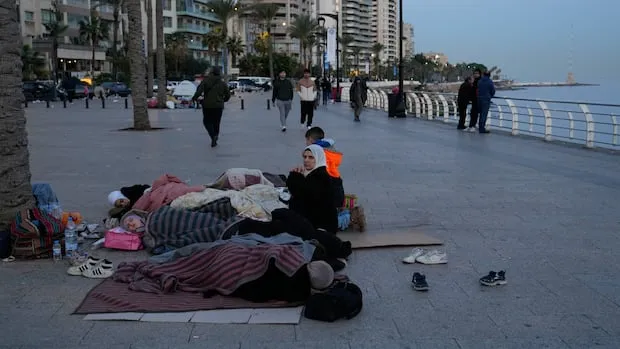
Residents of British Columbia with family ties to Lebanon watch the escalating Middle East conflict with growing anxiety. Israeli airstrikes and evacuation orders drive civilians from their homes, heightening fears that ordinary people will suffer the heaviest toll. The violence follows U.S. and Israeli strikes on Iran that killed Supreme Leader Ali Khamenei a week ago. Hezbollah, the Iranian-backed militant group, responded by launching rockets and drones from Lebanon into Israel. Israel countered with widespread airstrikes targeting southern Lebanon and Beirut’s southern suburbs.
Lebanon’s Prime Minister Nawaf Salam urges the international community to intervene, stating that Lebanon “did not choose this war.”
Vancouver Artist Haunted by Memories of Past Conflict
Vancouver artist Marie Khouri, who fled Lebanon during the civil war around 50 years ago, sees echoes of her traumatic youth in the current crisis. She left in 1975 after witnessing extreme violence as a teenager, including the assassination of her father.
“I saw things at the age of 14, 15, that I should have never witnessed,” Khouri said. Her sister and brother-in-law remain safe for now, but she expresses deep concern. “A month ago, who would have thought that the Middle East would be in flames again like it is today? I’m very scared.”
Khouri emphasizes the enduring scars of war. “Behind every death, there’s a father, a mother, a shattered family, there’s a loss. It’s going to take years to reconstitute.”
Honorary Consul Highlights Displacement Crisis
Nicholas Kahwaji, Lebanon’s honorary consul in Vancouver, reports that many Lebanese British Columbians anxiously track relatives fleeing repeated evacuation orders. “The main concern is where are these families? Are they still alive? Are they able to go to a safe area?” he said.
Over half a million people have been displaced in days, overwhelming shelters and straining food supplies, Kahwaji notes. He calls on Ottawa to advocate for a ceasefire, boost humanitarian aid, and simplify family reunifications in Canada.
Rising Casualties and Mass Evacuations
Lebanon’s Health Ministry reports 217 killed and 798 wounded since Israeli strikes began on Monday. A Thursday evacuation order in Beirut triggered massive traffic jams as hundreds of thousands fled.
Bachir Ayoub, Oxfam’s Lebanon country director, describes the scenes as “heart-wrenching.” Israeli forces urge civilian evacuations while intensifying operations against Hezbollah.
Canada Supports Citizens Abroad
More than 24,000 Canadians in Lebanon have registered with the federal government, and over 700 have sought assistance to depart. Foreign Affairs Minister Anita Anand outlines charter flights, reserved commercial seats, and regional support.
The Canada Border Services Agency has paused removals to Lebanon and Israel amid ongoing hostilities, excluding those inadmissible due to criminality, human rights violations, organized crime, or security risks.
Iranian Vancouverites Celebrate Leadership Change
In contrast, some in Vancouver’s Iranian community view the strikes on Iran positively. Masoud Zamani, spokesperson for Mission for My Motherland, calls Khamenei’s death a milestone. “We are here to celebrate the fortunate death of Iran’s dictator, who ruled Iran with an iron fist,” he said.
Nearly 2,500 people rallied Saturday outside the Vancouver Art Gallery in solidarity with Iranians, amid crackdowns on protests that activist groups say claimed thousands of lives. “Iranians have endured years of trauma,” Zamani added. “We hope for a free democratic Iran, one in which principles of democracy are observed, where all individuals with different walks of life and political beliefs can co-exist peacefully.”
One participant described war against totalitarian regimes as “a necessary evil,” thanking U.S. and Israeli intervention. Yet Khouri laments the shared suffering across communities. “That’s life when you live in the Middle East. Many Lebanese families, Iranian families, Syrian families, Palestinian families, Jewish families … we are all wounded.”
