

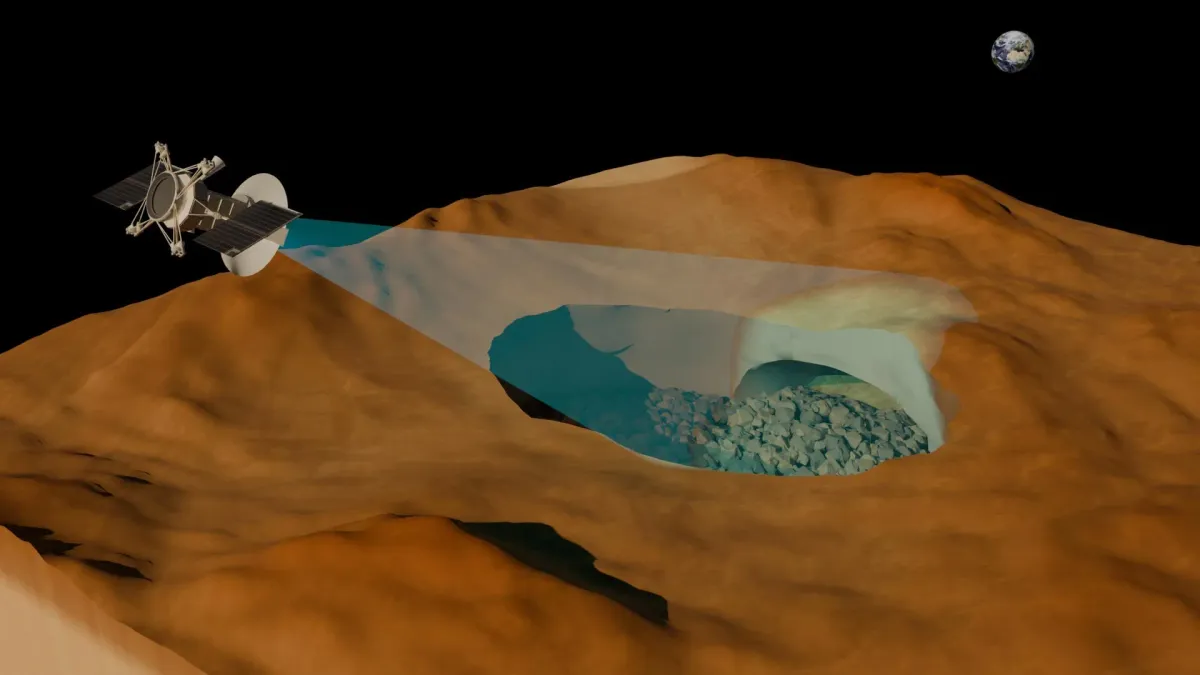
Scientists have identified compelling radar evidence of a vast underground lava tube on Venus, shedding new light on the planet’s volcanic past. Reanalysis of data from NASA’s Magellan spacecraft points to a large empty conduit near the Nyx Mons volcanic region. This structure spans nearly a kilometer in width and stretches dozens of kilometers beneath the surface.
A Glimpse into Venus’s Subsurface
Volcanic features like lava tubes appear on Mars and the Moon, and now evidence confirms their presence on Venus. Researchers at the University of Trento, supported by the Italian Space Agency, detected the cavity through advanced radar analysis. The findings appear in Nature Communications.
“Our knowledge of Venus remains limited, with no prior direct observations of subsurface processes on this twin to Earth,” states Lorenzo Bruzzone, research coordinator and full professor of telecommunications at the University of Trento’s Department of Information Engineering and Computer Science. “This volcanic cavity validates long-held theories and deepens insights into Venus’s evolutionary processes.”
Challenges in Spotting Lava Tubes
Lava tubes form underground and stay hidden unless ceiling collapses expose pit-like skylights. Venus’s thick cloud cover blocks optical imaging, forcing reliance on radar that penetrates the atmosphere. NASA’s Magellan mission from 1990 to 1992 mapped the planet using synthetic aperture radar, providing key data for this discovery.
Analysis of Nyx Mons Features
Teams examined radar images of surface collapses near potential skylights using specialized techniques. “Analyses revealed a large subsurface conduit in the Nyx Mons region,” Bruzzone explains. “We interpret it as a lava tube with a one-kilometer diameter, at least 150 meters of roof thickness, and a void depth exceeding 375 meters.”
Conditions Favoring Giant Tubes on Venus
Venus’s lower gravity and dense atmosphere enable molten lava to form thick crusts rapidly, sustaining wide channels. The detected tube exceeds most Earth examples and matches the largest lunar ones, consistent with Venus’s oversized lava flows compared to other rocky planets.
Pathways for Future Exploration
Current data confirms the cavity near the skylight, but terrain analysis suggests extensions up to 45 kilometers, supported by nearby pits. Upcoming missions like ESA’s Envision and NASA’s VERITAS will deploy advanced radars for finer details. Envision’s subsurface radar could probe hundreds of meters deep, even without surface openings.
“This marks the start of extensive research,” Bruzzone concludes. “Higher-resolution data will test hypotheses and uncover more tubes.”
