

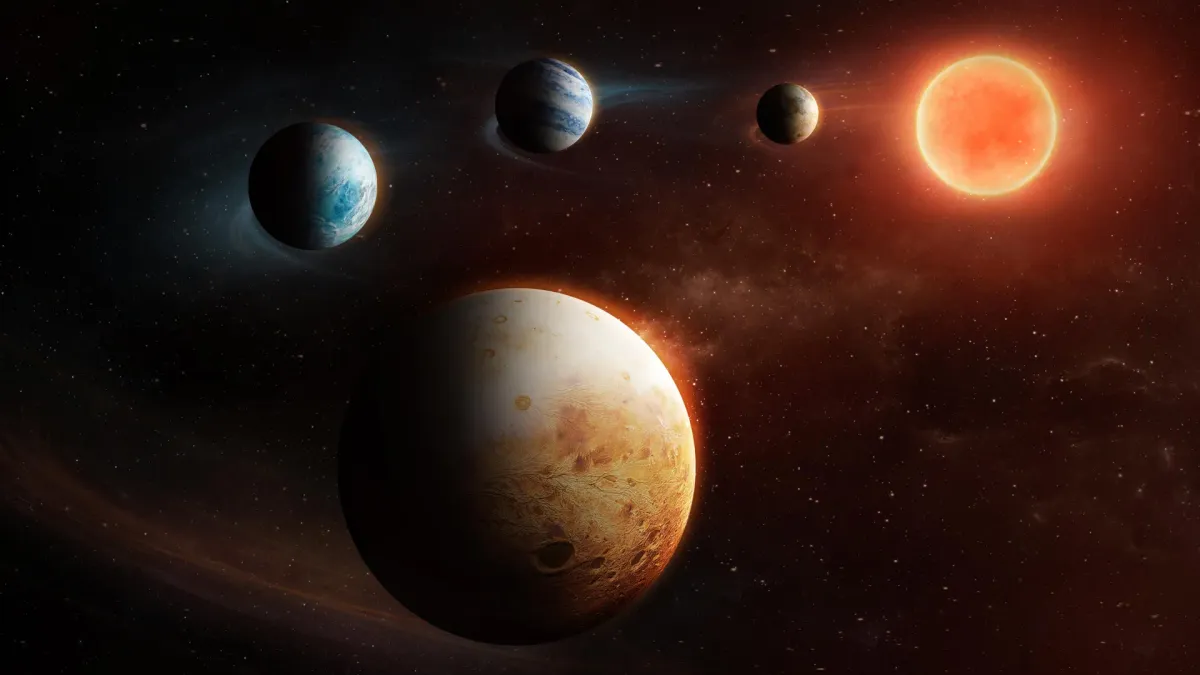
Astronomers have identified a distant planetary system orbiting the red dwarf star LHS 1903 that upends conventional planet formation theories. Observations reveal an unexpected rocky planet in the outermost orbit, contrasting the typical pattern of rocky worlds near the star and gas giants farther out.
Unconventional Layout Around LHS 1903
The system around the faint, cool red dwarf LHS 1903 initially aligns with expectations: a rocky inner planet followed by two Neptune-sized gas-rich worlds. However, extended monitoring uncovers a fourth planet, LHS 1903 e, farthest from the star. This outer planet shows rocky characteristics, defying the norm observed in our Solar System and numerous others.
Researchers, led by Prof. Ryan Cloutier from McMaster University’s Department of Physics and Astronomy and Prof. Thomas Wilson from the University of Warwick, analyzed data from ground-based telescopes and the European Space Agency’s CHEOPS satellite. “We’ve seen this pattern: rocky inside, gaseous outside, across hundreds of planetary systems. But now, the discovery of a rocky planet in the outer part of a system forces us to rethink the timing and conditions under which rocky planets can form,” Cloutier states.
Standard Planet Formation Theory
Current models explain planetary architectures through protoplanetary disks around young stars. Intense stellar radiation near the star strips gas from forming planets, resulting in rocky bodies like Mercury, Venus, Earth, and Mars. Cooler, distant regions allow gas giants such as Jupiter and Saturn to retain thick atmospheres.
Ruling Out Alternative Scenarios
The team tested explanations like massive collisions stripping atmospheres or orbital migrations. Advanced simulations and orbital analyses dismiss these possibilities. Instead, evidence supports sequential planet formation, where planets develop one by one as disk conditions evolve.
Inside-Out Planet Formation Hypothesis
This system suggests an “inside-out” process. Inner planets form first in gas-rich environments, becoming rocky or gaseous based on local conditions. By the time LHS 1903 e assembles, depleted disk gas prevents a thick atmosphere, yielding a rocky outcome. “It’s remarkable to see a rocky world forming in an environment that shouldn’t favour that outcome. It challenges the assumptions built into our current models,” Cloutier notes.
Cloutier adds, “As telescopes and detection methods become more precise, we are strengthening our ability to find planetary systems that don’t resemble our own and that don’t conform to longstanding theories. Each new system adds another data point to a growing picture of planetary diversity — one that forces scientists to rethink the processes that shape worlds across the galaxy.”
