

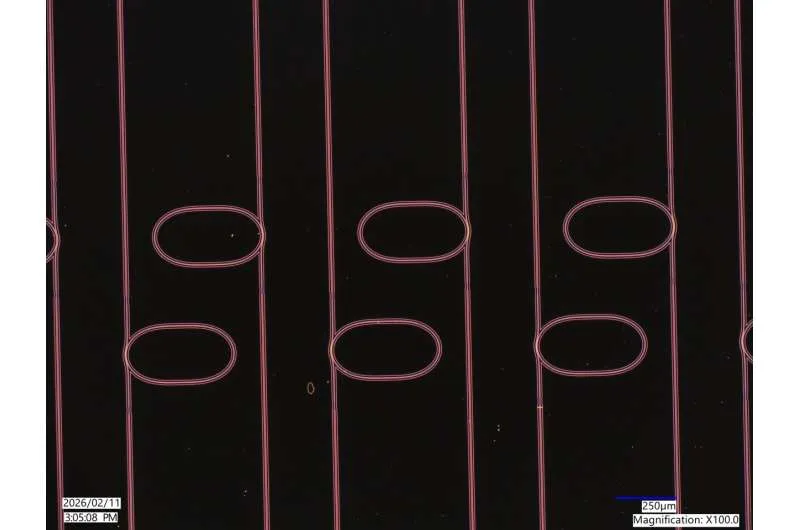
Researchers at the University of Colorado Boulder have developed high-performance optical microresonators that trap light longer within microscopic chips, unlocking potential for next-generation sensor technologies.
These tiny devices build up light intensity by confining photons, enabling advanced optical operations with reduced power needs. “Our work focuses on using less optical power in these resonators for future applications,” said Bright Lu, a fourth-year doctoral student in electrical and computer engineering and lead author of the study. “One day, these microresonators could support sensors for navigation and chemical detection.”
Innovative Racetrack Design Reduces Losses
The team utilized racetrack-shaped resonators featuring Euler curves, smooth bends inspired by road and railway designs. This shape prevents abrupt turns that cause light scattering.
“Racetrack curves minimize bending loss,” explained Won Park, Sheppard Professor of Electrical Engineering and co-advisor. “This design choice drove the project’s key innovation.”
By smoothing light paths, the resonators cut losses dramatically, allowing photons to circulate extensively and interact more effectively.
Precision Fabrication with Electron Beam Lithography
Built in the Colorado Shared Instrumentation in Nanofabrication and Characterization (COSINC) cleanroom, the devices leverage a new electron beam lithography system for sub-nanometer precision.
“Traditional lithography faces wavelength limits, but electron beam lithography achieves sub-nanometer resolution essential for microresonators,” Lu noted. He highlighted the satisfaction of transforming glass films into functional optical circuits amid massive, precise equipment.
Chalcogenides Deliver Superior Performance
The microresonators employ chalcogenide semiconductor glasses, prized for high transparency and nonlinearity in photonics.
“Chalcogenides excel in photonics due to their transparency and nonlinearity,” Park stated. “These devices rank among the top performers using chalcogenides.”
“Chalcogenides challenge processing for nonlinear photonic devices but yield rewarding results,” added Professor Juliet Gopinath, a long-term collaborator. “Minimizing bend loss creates ultra-low-loss devices rivaling state-of-the-art platforms.”
Testing Confirms Exceptional Quality
ics Ph.D. student James Erikson led measurements, aligning lasers with waveguides to observe resonance dips in transmitted light. Sharp, narrow dips signal high-quality trapping.
“Deep, narrow resonances like a needle through the signal indicate top device quality,” Erikson said. “Seeing these sharp peaks confirmed we succeeded.”
Analysis accounted for absorption, transmission, and thermal shifts, as heating alters material-light interactions and risks damage.
Future Impact on Photonics and Sensing
These microresonators promise compact microlasers, chemical and biological sensors, plus quantum metrology tools. “They integrate lasers, modulators, and detectors into scalable systems,” Lu concluded. “The vision is mass production for manufacturers.”
The findings appear in Applied ics Letters.
