

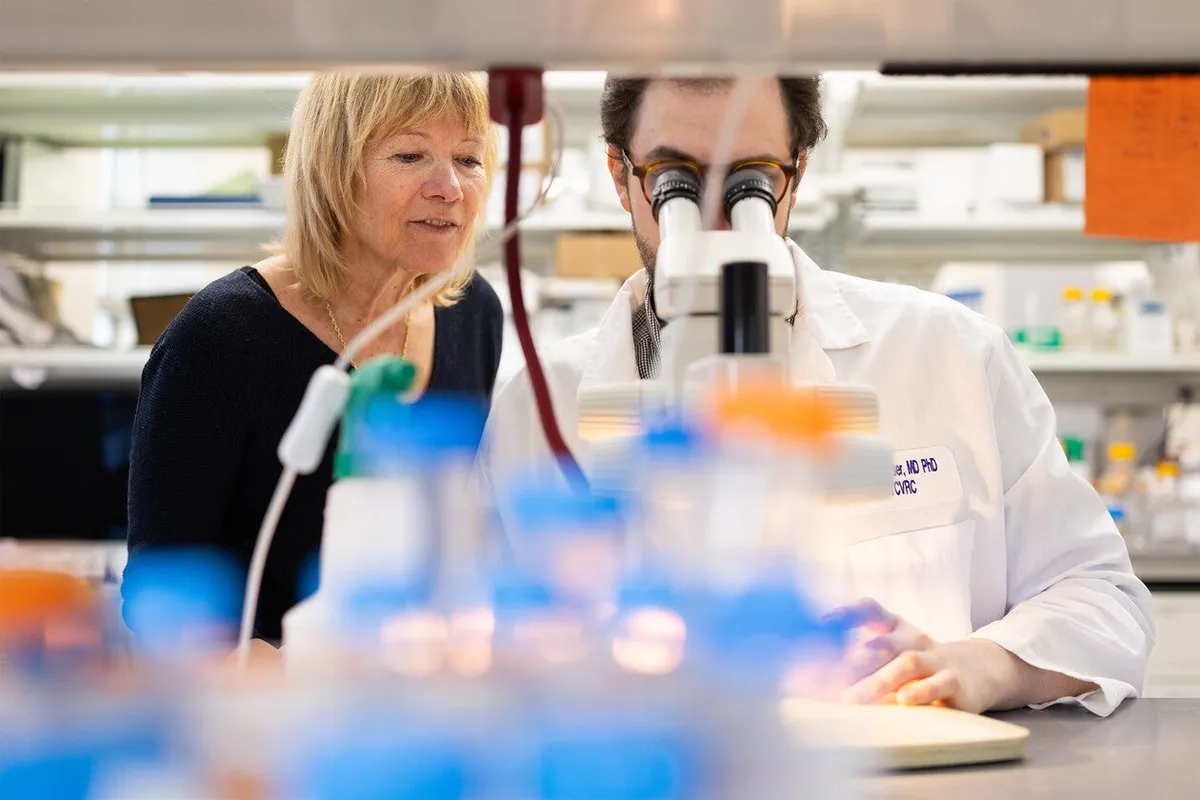
Developmental biologist Anne Eichmann initially pursued science for the joy of discovery. “I was drawn to science just for the fun of understanding how things work,” says Eichmann, Ensign Professor of Medicine (Cardiovascular Medicine) at Yale School of Medicine and professor of cellular and molecular physiology in Yale’s Faculty of Arts and Sciences.
Over time, she recognized the broader potential of her work. “You get to a point where you see that what you discovered could actually be good for humanity going forward,” Eichmann explains. Her lab at Yale developed D2B3, a drug delivery technology that temporarily opens the blood-brain barrier (BBB). This natural shield protects the brain but blocks many treatments. “This technology could make a big difference in people’s lives,” Eichmann states. “That is obviously what we all strive to do at the end of the day.”
Five Accelerator Funds Drive Commercialization
Eichmann advanced her research through The Blavatnik Fund for Innovation at Yale, active since 2017 in turning life sciences discoveries into solutions. Yale Ventures now leads five such funds: Blavatnik Fund, HealthTech Works (digital health and medtech), Colton Center for Autoimmunity (autoimmune diseases), Roberts Innovation Fund (engineering), and Planetary Solutions Impact Accelerator.
“One of the major goals of the university is to have as large a positive impact on society as we can,” says Josh Geballe, senior associate provost for entrepreneurship and innovation and managing director of Yale Ventures. “Yale invests well over $1 billion per year in research. These accelerator funds ensure that research outputs launch solutions to global challenges.”
Beyond Funding: Comprehensive Support
These funds target commercialization of faculty-led ideas. They offer targeted grants via competitive applications, tailored to each domain. Faculty gain access to industry experts, Yale’s executive network, investors, and field-specific training like workshops.
“Our research faculty are exceptionally busy and rarely have startup experience,” Geballe notes. “The accelerators provide funding and guidance from lab to market.”
Claudia Reuter, executive director of engineering innovation at Yale Ventures and director of the Roberts Innovation Fund, emphasizes a faculty-focused approach. “We prioritize customer service for our faculty, delivering quality resources for commercialization,” she says.
Yale Ventures supplies hands-on help from business experts, fellows, and students. “The ultimate goal is impact—treating diseases, renewable energy, quantum computing,” Geballe adds. Funds also bolster New Haven’s economy by encouraging local startups with ongoing faculty ties and resources. “Most companies stay local due to incubator sites and talent growth,” he observes.
Demonstrated Results and New Launches
HealthTech Works and Planetary Solutions Impact Accelerator prepare for initial awards. Established funds show strong outcomes: Colton Center supported 49 projects with over $5 million since 2020; Roberts Innovation Fund backed 30 projects with more than $2 million since 2022; Blavatnik Fund aided 98 projects with $24 million, spawning 35 biotech firms and eight clinical trials.
“Much of the intellectual horsepower in medical innovations originates in academic labs,” says Joseph Craft, Paul B. Beeson Professor of Medicine (Rheumatology) and scientific director of Colton Center. Morag Grassie, executive director of Blavatnik Fund, notes a shift: “Faculty now approach research translationally, seeking alternative funding.”
Ruzica Piskac, professor of computer science, and Scott Shapiro, Charles F. Southmayd Professor of Law, used Roberts funding for Alfred, a logic-based system for regulated sectors like insurance. “Even law professors struggle with rules—how can others comply?” Shapiro asks. Alfred acts as a concierge, asking minimal questions for explainable answers backed by legal sources.
Their 2024 startup, Leibniz AI, employs staff, pilots products, and draws VC interest. “Running a startup differs significantly from a lab,” Piskac reflects.
D2B3 Advances Toward Clinical Impact
Since her 2022 Blavatnik award, Eichmann’s D2B3 company assembled a launch team and advisory board, including biotech leader Franz Hefti. It raised over $500,000, won awards like Alexandria LaunchLabs Innovation Award, and joined IndieBio New York.
The technology enables drugs to cross the BBB for brain cancer, infections, and neurodegenerative diseases via simple IV injection. Preclinical tests in mice and primates focus on optimization, safety, and efficacy ahead of FDA approval. “Our approach could simplify treatment and transform lives for children and patients with neurological conditions,” Eichmann says. Yale Ventures support propels them closer to real-world change.
