

Ecuador declares Cuba’s ambassador, Basilio Antonio Gutiérrez, and his diplomatic staff persona non grata, ordering them to leave within 48 hours.
The Foreign Affairs Ministry invokes international diplomatic law for the measure but offers no specific reasons. Under the Vienna Convention, nations can expel diplomats without justification.
Drama at Cuban Embassy
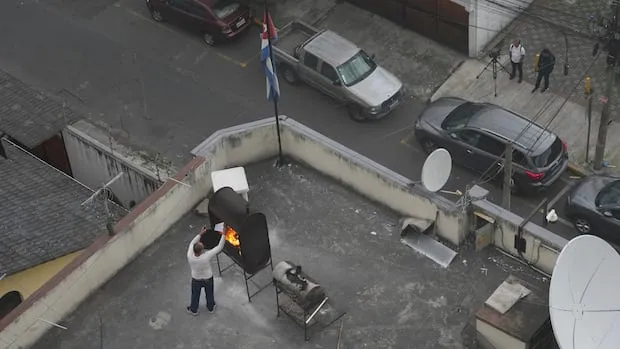
Shortly after the announcement, a man appears on the roof of the Cuban Embassy in Quito, burning documents in an oven. President Daniel Noboa posts video of the scene on social media, quipping, “A paper barbecue.” Officials decline to comment further or name the individual.
Cuba Denounces ‘Unfriendly Act’
Cuba’s government condemns the expulsion as an “unfriendly and unprecedented act that significantly damages historic relations of friendship and cooperation.” The Foreign Ministry states it reflects “contempt for diplomatic practices and courtesies observed internationally.”
Foreign Minister Bruno Rodríguez posts on X that the timing appears “no coincidence,” aligning with U.S. pressure on Cuba and a upcoming Miami summit of Latin American leaders, which Noboa plans to attend.
Recent Diplomatic Moves
The expulsion follows President Noboa’s Tuesday executive order revoking diplomatic duties for Ecuador’s ambassador to Cuba, José María Borja, also without explanation. That day, Ecuador and the United States launch joint military operations targeting organized crime.
Noboa positions himself as a firm leader against rising violence from armed groups.
Broader Context and Pressures
The action occurs amid intensified U.S. pressure on Cuba under President Donald Trump, escalating after a U.S. operation removes Venezuelan leader Nicolás Maduro. Cuba faces economic collapse in 2026 due to oil restrictions, causing fuel shortages, blackouts, and food scarcity.
Peter Kornbluh, author of Back Channel to Cuba, describes the situation as an existential threat to Havana, yet notes mutual interest in negotiations.
Ecuador collaborates with the U.S. against regional drug trafficking. Bilateral ties with Cuba date to 1960 but fluctuate with Ecuadorian politics.
Ideological Shift?
Andrea Endara, coordinator of Political Science and International Relations at Casa Grande University, views the decision as having an “ideological component,” with Noboa aligning to U.S. interests.
This fits recent tensions, including Ecuador’s 2024 raid on Mexico’s embassy to arrest a former vice president—deemed a violation of international law, severing ties—and an ongoing trade war with Colombia over border security.
