

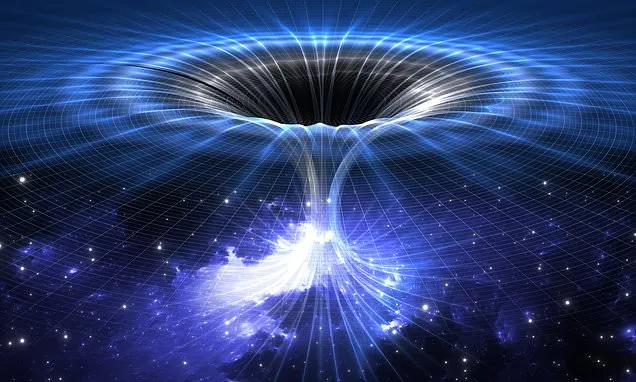
Physicists propose that dark matter could generate a stable wormhole at the Milky Way’s center, potentially linking distant regions of the universe. This structure, akin to a tunnel through spacetime, might span 32,600 light-years, offering a shortcut across cosmic distances.
Understanding Wormholes
Wormholes represent extreme distortions in spacetime, where intense gravity connects remote points, possibly separated by light-years or time itself. Unlike black holes that trap matter, wormholes feature two mouths linked by a throat—one pulling in material like a black hole, the other expelling it like a white hole.
Astrophysicist Dr. Saibal Ray from GLA University describes a wormhole as a ‘tunnel between two manhole covers,’ with one end as the entry and the other as the exit. For traversability, the throat must remain wide and stable enough for objects to pass through instantly.
Dark Matter’s Stabilizing Force
Dark matter, comprising 27 percent of the universe’s mass, exerts gravitational influence without direct detection, shaping galaxies via its pull. Researchers argue its unique density and collapse in dense environments could warp spacetime into a wormhole.
Dr. Ray notes that dark matter’s ‘condensate properties’ in specific models trigger a traversable throat during gravitational collapse. In spiral galaxies like the Milky Way, abundant dark matter forms a halo extending up to one million light-years, potentially sustaining such a structure at the core and edges.
Scale and Implications
Calculations indicate a central Milky Way wormhole measures 32,600 light-years across. Cosmologist Professor Dejan Stojkovic from the University at Buffalo suggests that if large enough, it could accommodate humans or spacecraft, enabling rapid interstellar travel reminiscent of science fiction.
The Hernquist dark matter profile used in the study violates the Null Energy Condition, providing the exotic matter needed to prevent collapse—a key requirement for stable wormholes.
Skeptical Perspectives
Not all experts agree. Astrophysicist Dr. Andreea Font from Liverpool John Moores University contends there is no evidence dark matter acts as exotic matter beyond standard gravitational attraction. She highlights that a wormhole of this size demands 100,000 times the galaxy’s mass-energy in negative form—equivalent to thousands of galaxies.
While theoretically possible under general relativity, the proposal faces challenges aligning with observed Milky Way physics, though proponents like Professor Stojkovic believe nature could produce such features.
