

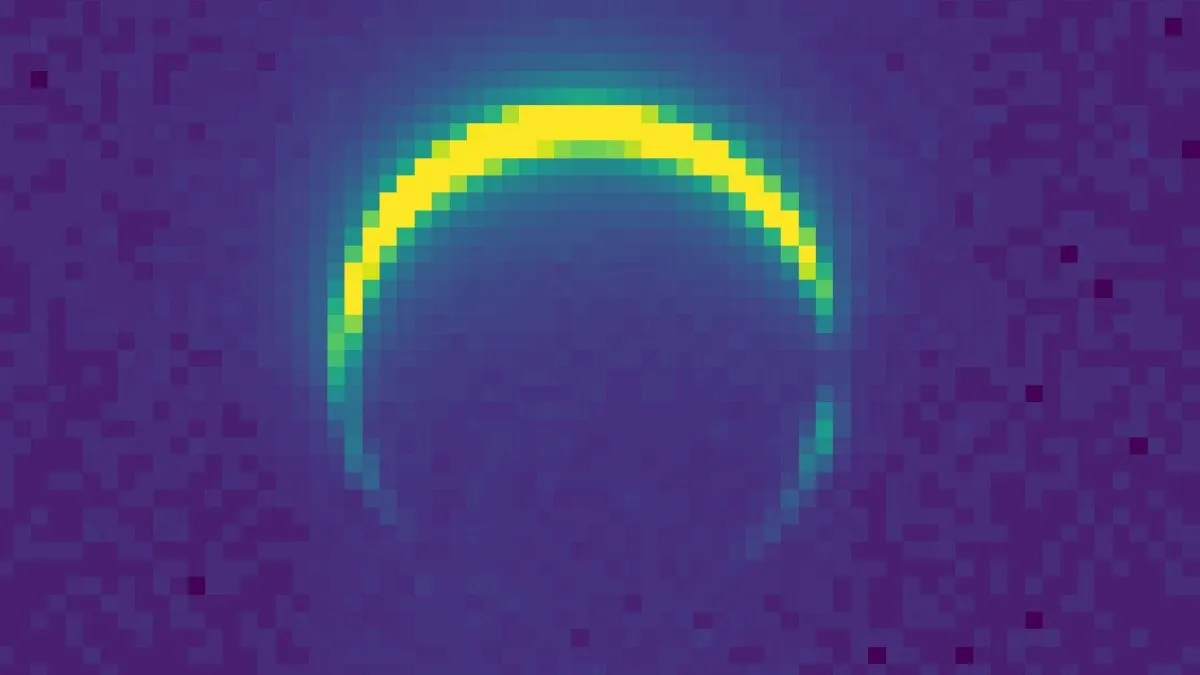
NASA’s Psyche spacecraft recently turned its cameras toward Mars, capturing the planet as a striking thin, glowing crescent reminiscent of Earth’s crescent Moon. The image was taken on May 3, 2026, when the spacecraft was approximately 4.8 million kilometers from the Red Planet.
Mars Gravity Assist Boosts Psyche’s Journey
Psyche is not landing on Mars but using the planet’s gravity for a slingshot maneuver, known as a gravity assist. This technique harnesses Mars’s gravitational pull to accelerate the spacecraft without additional fuel. The closest approach occurs on May 15, 2026, propelling Psyche toward its primary target: the metal-rich asteroid Psyche in the asteroid belt between Mars and Jupiter. Arrival at the asteroid is slated for 2029.
High-Phase Angle Creates Crescent Effect
The crescent appearance results from Psyche’s position at a high-phase angle, with the Sun located behind and above both the spacecraft and Mars. This geometry illuminates only a narrow sliver of the planet’s sunlit side.
The multispectral imager on board captured the image in just 2 milliseconds across various light wavelengths. Despite the brief exposure, certain areas appear oversaturated due to unexpectedly intense reflected sunlight from Mars.
A subtle gap on the right side of the crescent aligns with Mars’s north polar ice cap. Scientists attribute this to seasonal hazes and clouds blocking scattered light. Atmospheric dust further enhances the effect, causing the glow to curve more prominently around the planet.
These images serve to calibrate the spacecraft’s cameras ahead of its asteroid rendezvous in 2029.
