

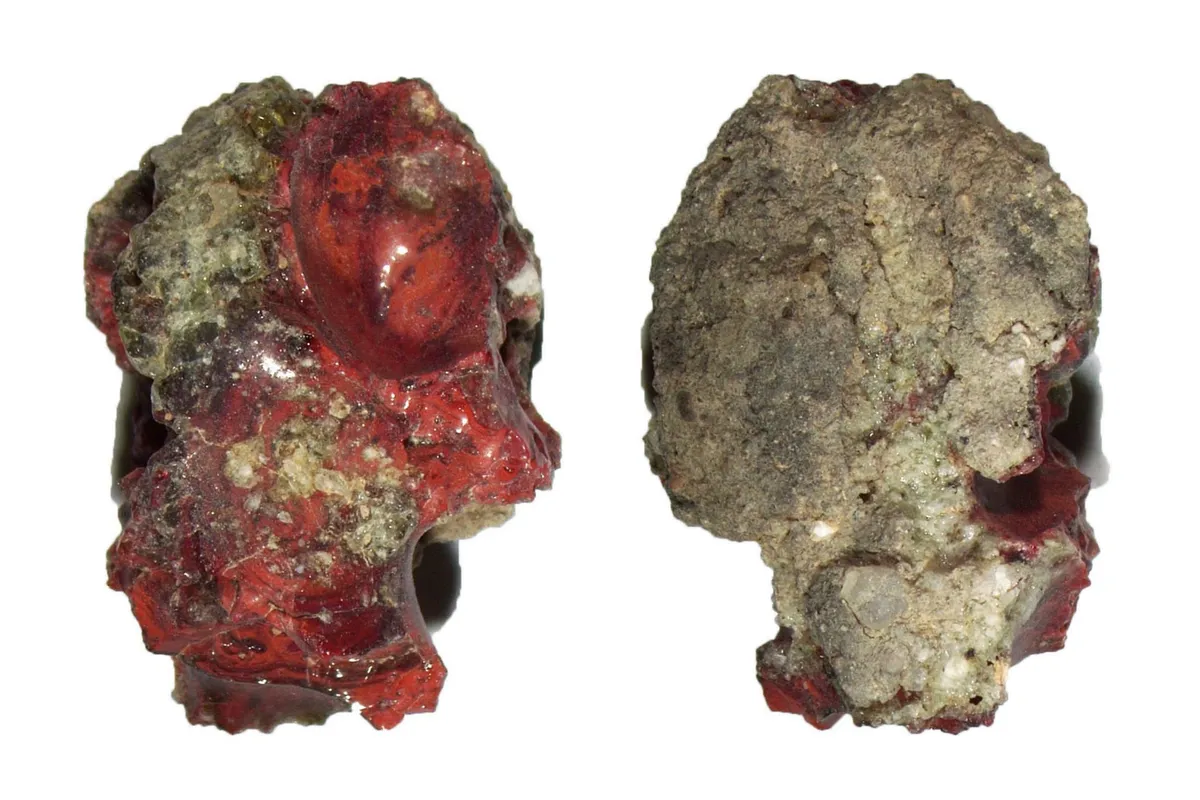
The Trinity test, America’s inaugural plutonium implosion detonation on July 16, 1945, vaporized a 100-foot tower along with its copper wiring, sheathing, and cables. This 21-kiloton explosion unleashed extreme temperatures exceeding 2,732 degrees Fahrenheit and pressures of about one million pounds per square inch on aerosolized metals and desert sandstone dust in New Mexico.
Discovery of a New Crystalline Phase
Researchers across Europe and the United States have identified a previously unknown crystalline phase of a clathrate compound made from silicon, calcium, iron, and copper from the blast. This structure forms a complex lattice that traps smaller molecules or atoms like nanoscale cages.
Luca Bindi, chair of mineralogy and crystallography at the University of Florence in Italy, and his team describe it as “the first crystallographically confirmed identification of a clathrate structure among the solid-state products of a nuclear explosion.” This finding promises to advance knowledge of such compounds.
Applications in Material Science
Clathrates hold value in high-tech fields. They store lithium ions in batteries during charge cycles and enable customized silicon compounds doped with elements to boost solar cells, quantum computers, and other devices.
The team highlights how extreme events like nuclear blasts, lightning, and meteor impacts act as natural labs for novel crystals. This clathrate offers a unique case beyond standard synthesis methods, aiding models of molecular formation.
Location and Analysis
The crystal resides in red trinitite, a glassy sand fragment from the test enriched with metals from the tower and instruments—unlike the common pale green variety. Collaborators from Princeton, Carnegie Mellon, and the Slovak Academy of Sciences used single-crystal X-ray diffraction to map its 3D structure, featuring dodecahedral and tetrakaidecahedral silicon cages.
They compared it to a quasicrystal found at the site in 2021 but found no direct link. Further phases likely await discovery in red trinitite’s metallic droplets, reflecting the blast’s unique conditions.
