

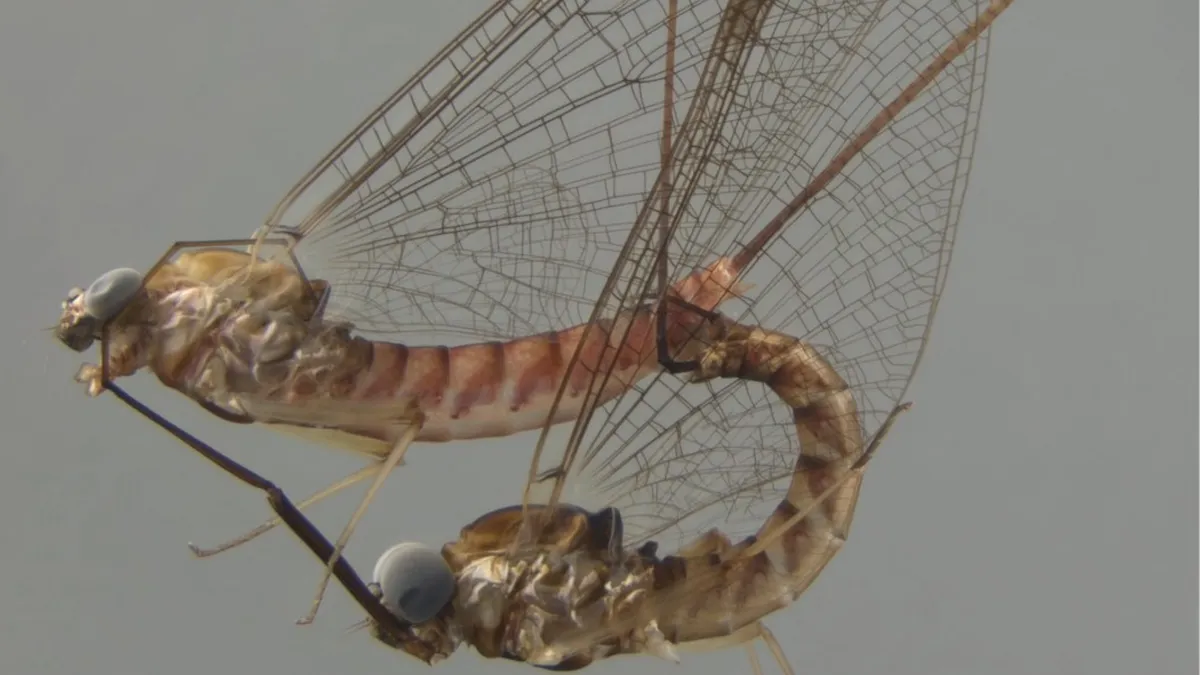
Scientists in Germany captured mating mayflies mid-flight using a long-handled net and freezing spray, preserving the insects for detailed analysis of their reproductive anatomy. This approach enabled high-resolution imaging that uncovers the dynamic changes in male genitalia during copulation.
Mayfly Life Cycle and Mating Drive
Mayflies spend most of their lives as aquatic larvae in freshwater environments. Upon emerging as adults, they cease feeding—their digestive system seals shut—and dedicate their brief existence solely to reproduction. Adult mayflies swarm over water bodies, where mating unfolds rapidly in the air, making close observation challenging.
Capturing the Act in Germany’s Black Forest
Researchers targeted Ecdyonurus venosus mayflies in the Black Forest. They scooped copulating pairs with a specialized net. Most pairs separated immediately upon capture, but persistent couples endured a quick freeze with spray before preservation in ethanol. Advanced synchrotron X-ray microtomography at the Karlsruhe Institute of Technology then generated 3D digital models of the frozen specimens.
Decoding Genital Function
“The aim of this work is to clarify the function of genital interactions during copulation in the mayfly genus Ecdyonurus, and to unravel the mechanisms that lead to the change in the penis configuration during mating,” researchers state in their analysis.
Male mayflies possess a paired penis structure with two lobes flanked by claspers and interspersed spines. During mid-air mating, the male latches onto the female from below, gripping the base of her wings with forelegs while bending his abdomen upward. Claspers secure the connection, allowing the paired penis to engage the female’s rear-opening copulatory pouch.
Dynamic Transformations in Action
Micro-CT scans reveal striking adaptations: Powerful muscles deform the penis shaft, folding the lobes over. Simultaneously, penial spines extend and pierce the female’s pouch membrane. This mechanism stretches the pouch, accommodating large volumes of sperm stored in a front-folded membrane.
Such robust attachment proves essential, as rival males often attempt to interrupt the coupling. Mating concludes swiftly; males soon perish from swarming exhaustion, while females deposit eggs upstream before succumbing as well. Researchers remain uncertain if individuals mate multiple times.
