

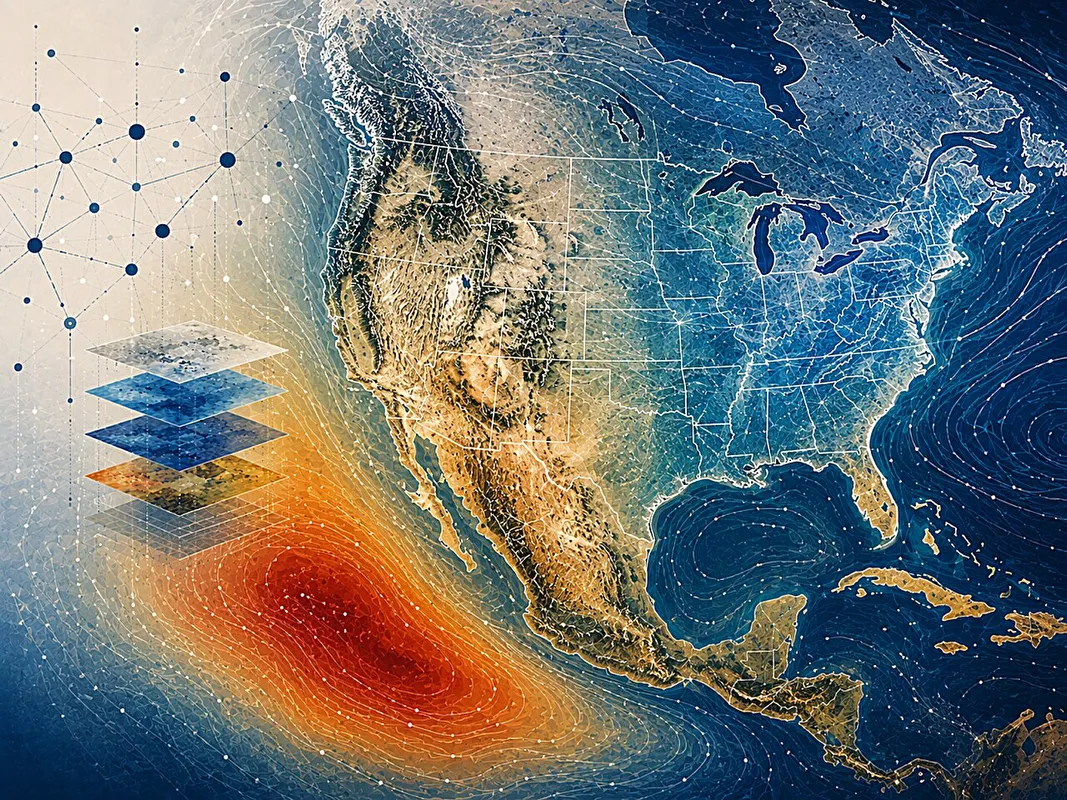
Artificial intelligence revolutionizes climate science by unveiling the ical mechanisms influencing the planet’s weather patterns. Researchers led by Antonios Mamalakis from the University of Virginia’s School of Data Science and Department of Environmental Sciences employ advanced AI systems to identify drivers of winter precipitation across the United States. These models not only enhance seasonal forecasts but also verify that predictions stem from genuine climate signals rather than statistical anomalies.
The analysis tackles a core challenge in climate research: forecasting precipitation months ahead. Results indicate potential improvements in preparing for droughts, floods, wildfires, and water shortages, especially in southern regions where winter precipitation proves far more predictable than in the north.
Importance of Explainable AI in Climate Forecasting
Explainable AI (XAI) builds trust by demystifying AI decision-making processes. Mamalakis emphasizes, “We want to know whether or not the AI model we have trained predicts correctly for the right reasons.” In high-stakes applications like hurricane tracking, models must avoid shortcuts that fail under novel conditions, potentially leading to inaccurate forecasts.
Evaluation focuses on ically meaningful signals, ensuring AI contributes reliably to environmental predictions.
Higher Predictability in the Southern US
Southern states, particularly the Southeast and Gulf Coast including Florida, Georgia, the Carolinas, and Virginia, exhibit superior winter precipitation forecasting accuracy. This aligns with established links to El Niño and La Niña events in the tropical Pacific.
Mamalakis notes, “The signal of El Niño and La Niña events is much stronger over the southern U.S. For example, during El Niño years, the jet stream tends to intensify and shift to the south, bringing more winter storms and wetter conditions.” Across tested AI models, the tropical Pacific emerges as the primary predictor, with additional influences from the tropical Atlantic.
Meta Consensus Validates AI Insights
A key innovation, “meta consensus,” gauges when multiple AI models converge on ical drivers. Mamalakis explains, “If the models agree about what they agree on and where they disagree, that’s a good indicator they have learned something ical.” Strongest agreement occurs during pronounced El Niño and La Niña periods, signaling robust scientific discovery.
This approach positions AI as a tool for advancing climate understanding beyond mere prediction.
Balancing AI Benefits with Sustainability Challenges
While AI accelerates climate insights, its energy demands pose concerns. Mamalakis highlights the “sustainability paradox”: “On the one hand, AI can help accelerate science and help us gain new knowledge. On the other hand, at large scales, especially in massive data centers, it can require ridiculous amounts of energy.” Smaller, localized models mitigate this for now.
Ultimately, reliable long-range forecasts enable better water management, flood and drought preparedness, and responses to climate extremes.
