

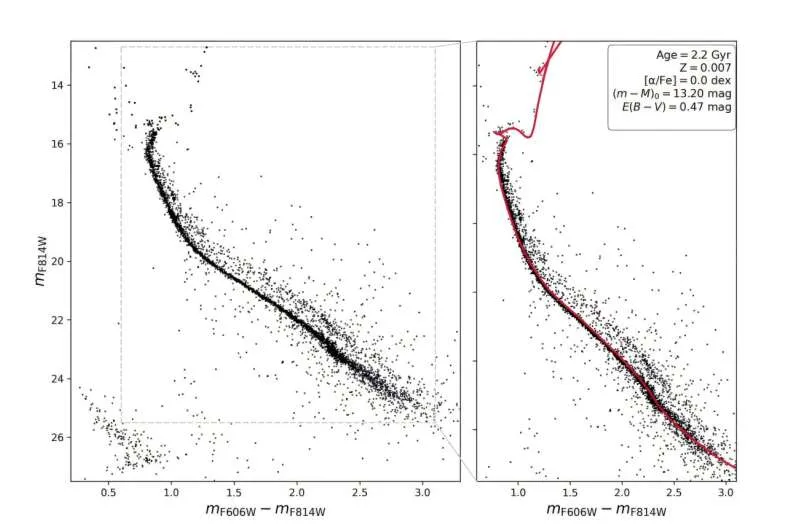
Astronomers have examined Hubble Space Telescope images of the open cluster NGC 2158 to uncover details about its binary star population. The analysis provides key insights into the cluster’s stellar composition and evolution.
Characteristics of NGC 2158
NGC 2158 lies approximately 11,000 light-years from Earth in the constellation Gemini. This galactic open cluster spans a radius of about eight light-years and belongs to the Milky Way’s old thin disk population. Classified as metal-poor and intermediate-age, it dates back around two billion years.
Open clusters like NGC 2158 form from the same giant molecular clouds and offer valuable data on galactic formation and evolution. A team led by Anastasia Marchuk of the University of Padua in Italy used deep Hubble imaging to probe its binary stars down to about 0.14 solar masses.
Researchers note, “This dataset enables the first detailed study of binaries in this cluster.” Binary systems play a crucial role in cluster dynamics, influencing structure and observable traits.
Binary Star Fraction and Trends
The study identifies a global binary fraction of roughly 38% in NGC 2158 for main-sequence pairs with mass ratios above 0.5. This figure aligns with patterns in other open clusters.
The binary fraction drops with decreasing stellar mass, from 52% near 1.0 solar mass to 11% at 0.2 solar masses. This decline mirrors trends in the galactic field, suggesting similar formation processes for cluster and field binaries.
No evidence appears for wide binaries with projected separations exceeding 440 AU.
Mass Function Insights
The cluster’s mass function features three regimes: a steep slope of -2.49 for high-mass stars, -1.11 for low-mass stars, and -0.08 for very low-mass stars. A slope shift occurs around 0.9 solar masses, matching galactic open cluster norms.
Analysis reveals a shortage of stars below 0.3 solar masses and a discontinuity in the main sequence at that threshold, highlighting unique aspects of NGC 2158’s stellar population.
