

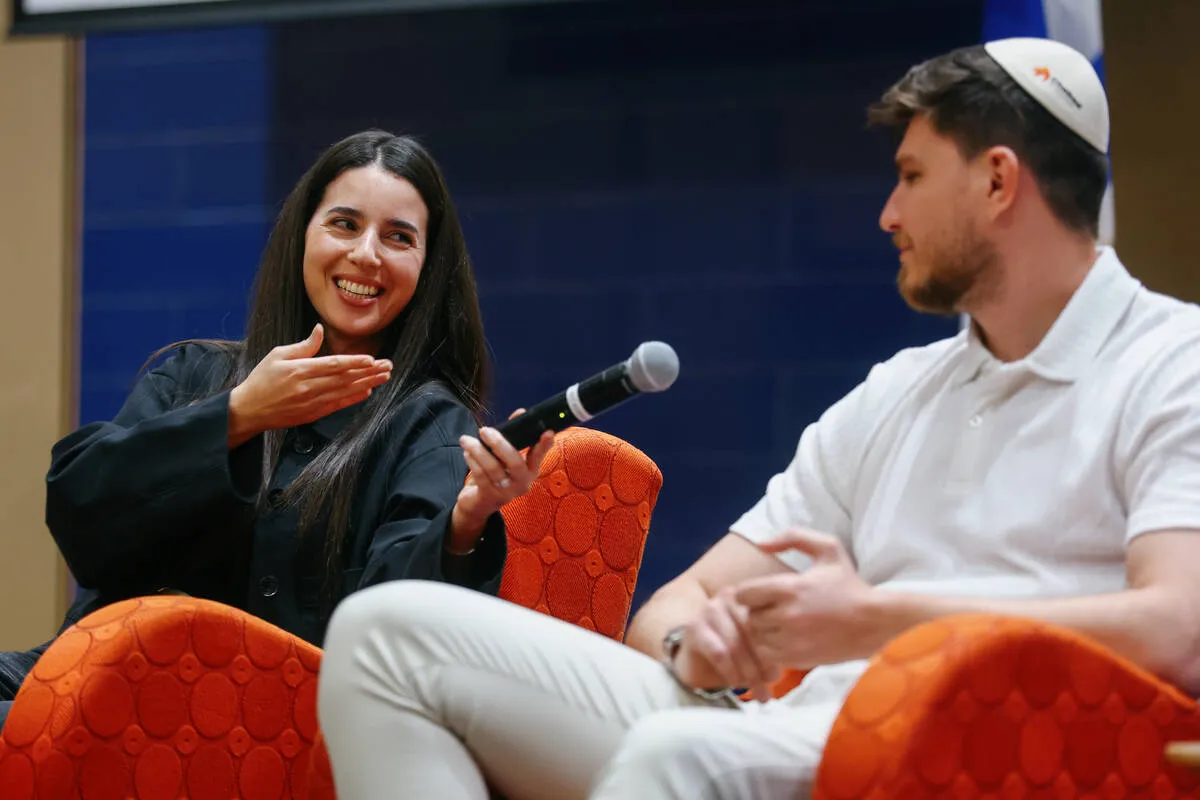
Sapir Cohen hesitated before heading to Kibbutz Nir Oz with her boyfriend, Sasha Troufanov, from their home in northern Israel. On Oct. 6, 2023, the couple, who had just moved in together, faced relationship strains. Cohen welcomed the weekend visit to Troufanov’s parents for a change of scenery.
“Sasha didn’t want to go,” Cohen recounted to about 100 attendees at The Adelson School in Las Vegas. “He didn’t know why, but he wanted to cancel it.” Despite his reluctance, they proceeded, unaware of the horror awaiting them.
The Oct. 7 Attack
The following morning, sirens and rockets jolted Cohen awake around 6 a.m. Unfamiliar with the area, she and Troufanov soon spotted hundreds of terrorists infiltrating the community. They hid under a bed, but armed intruders burst into their room.
“I stood up in front of one terrorist with my hands up,” Troufanov described. “He immediately pointed his rifle at me, and I was just waiting to see the rounds pierce my chest, but it didn’t happen.”
The pair were separated. Troufanov suffered severe beatings: his left leg snapped in half, a stab wound to the shoulder, and his head split open by a rifle butt. He endured transfers between apartments, surviving on scant dates, before confinement in an underground tunnel cage for nearly 500 days.
Cohen, held in the tunnels as well, gained release after almost two months. The assault claimed over 1,200 lives, mostly civilians, and saw about 250 abductions.
Finding Strength Underground
Troufanov, a former Israeli military intelligence specialist born in Russia and raised in Israel since age 3, confronted profound isolation. “For half of the day, it was so dark that you couldn’t even see your hand if you put it in front of your face,” he said. “And it was so quiet, the type of silence where you could hear a cockroach walking on the concrete.”
Once a secular engineer skeptical of faith, Troufanov shifted during captivity. Everything familiar vanished, prompting positive reflections on loved ones and prayer. “Every time I needed to find strength, I found myself sitting there, praying,” he shared. “I came from a background of science… but I started to think about nature and the beautiful nature we have all around us.”
Reunion and Resilience
While apart, Cohen grappled with uncertainty, yet chose to wait, honoring a promise to Troufanov’s mother. Upon his release a year ago, Troufanov’s newfound belief thrilled her. “When Sasha came back, and when he says that he believes in God, it was proof that he’s the one for me,” Cohen affirmed.
Now engaged, they plan a wedding next month and family life in Israel. Troufanov’s father perished in the attacks; he navigates lasting physical and mental scars, using crutches from injuries. Cohen battled post-release depression, irritated by minor complaints.
“The love we felt when we got out, not only from Israel, but from all around the world, that has helped us so much,” Troufanov noted. Cohen added that the ordeal fostered national pride: “Before Oct. 7, I didn’t feel a part of our nation… I’m so proud of our nation now.” She recalled a captor’s admission: “When they are together, the Jewish people are very, very strong.”
