

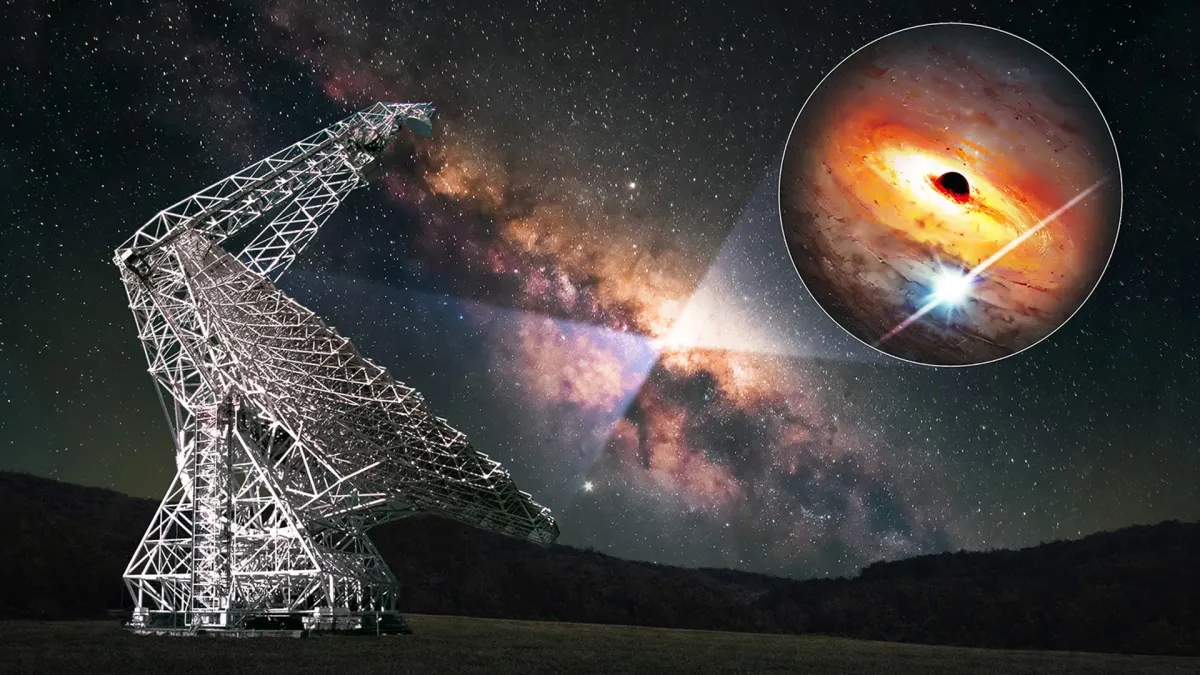
Astronomers scanning the Milky Way’s core have identified a promising signal: an ultra-fast pulsar candidate spinning every 8.19 milliseconds close to Sagittarius A*, the supermassive black hole at our galaxy’s center. This discovery could provide a unique probe into space-time distortions caused by extreme gravity.
Breakthrough Listen Galactic Center Survey Yields Key Findings
Researchers from Columbia University, collaborating on the Breakthrough Listen initiative, conducted one of the most sensitive radio surveys targeting pulsars in the galaxy’s turbulent central region. The effort, led by recent Columbia PhD graduate Karen I. Perez, uncovered the millisecond pulsar (MSP) candidate near Sagittarius A*. The results appear in a new study published in The Astrophysical Journal.
Pulsars as Cosmic Clocks for Testing General Relativity
Pulsars, the dense remnants of massive stars known as neutron stars, rotate rapidly while emitting powerful magnetic fields and beams of radio waves. These beams sweep across space like lighthouse signals, arriving at Earth with exceptional regularity when unaffected by external forces. Millisecond pulsars, spinning hundreds of times per second, offer even greater timing precision.
“Any external influence on a pulsar, such as the gravitational pull of a massive object, would introduce anomalies in this steady arrival of pulses, which can be measured and modeled,” explained Slavko Bogdanov, a research scientist at the Columbia Astrophysics Laboratory and co-author of the study. “In addition, when the pulses travel near a very massive object, they may be deflected and experience time delays due to the warping of space-time, as predicted by Einstein’s General Theory of Relativity.”
Sagittarius A* packs roughly 4 million solar masses, exerting profound gravitational effects on nearby matter and light.
Follow-Up Efforts and Public Data Access
Teams are now scrutinizing additional observations to verify the pulsar’s authenticity. To foster global collaboration, Breakthrough Listen has released the dataset publicly, enabling independent analyses worldwide.
“We’re looking forward to what follow-up observations might reveal about this pulsar candidate,” Perez stated. “If confirmed, it could help us better understand both our own galaxy and General Relativity as a whole.”
