

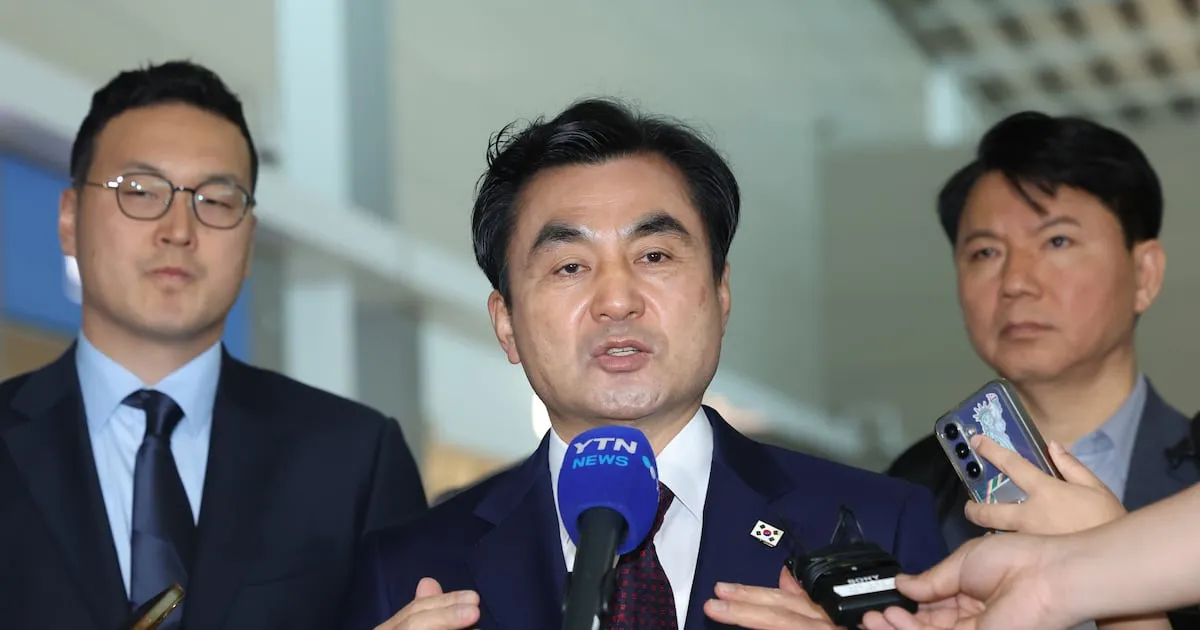
South Korea’s Defense Ministry Director-General Ahn Kyu-back announced that the United States sees no obstacles to accelerating the full transfer of wartime operational control (OPCON), even for internal staffing adjustments.
Recent US-Korea Discussions
Ahn made these remarks following a meeting with U.S. officials on October 10. He highlighted that Korea first agreed in principle to the full OPCON transfer during the 2015 Security Consultative Meeting (SCM), where it hosted the 47th session.
Since then, discussions have progressed on an appropriate scale, with the number of internal personnel still under review. Until October 14, delegations continue negotiations on core issues, including the transfer timeline and personnel composition.
Scheduled talks include meetings with the U.S. State Department’s director-general, the Defense Secretary’s chief of staff, the Secretary of Defense’s policy director, and others. A key session with Hegseth is set for November 11 in Washington, where Korea will outline its stance on the full transfer.
Korea’s Push for 2028 Completion
Ahn attended last year’s 57th SCM, where he stressed the urgency of the transfer, stating, “This meeting is the main focus.” Korea plans a two-year review post-SCM, targeting 2028 for full OPCON handover.
Currently, Korea operates under Initial Operational Capability (IOC), Full Operational Capability (FOC), and Full Materiel Capability (FMC) phases. However, differences persist with the U.S. side.
Recently, during a Brussels meeting, President Biden and the U.S. chief of staff proposed a 2029 roadmap, allocating one division base to Korea for the transfer.
Addressing Challenges and Priorities
Ahn emphasized that presidential directives take precedence in managing dual operations and related matters. “Appropriate adjustments are crucial, and if details from the U.S. side are shared, significant issues in securing considerations—like construction—do not exist,” he stated.
He added potential for an initial joint project, underscoring collaborative opportunities amid ongoing diplomacy.
