

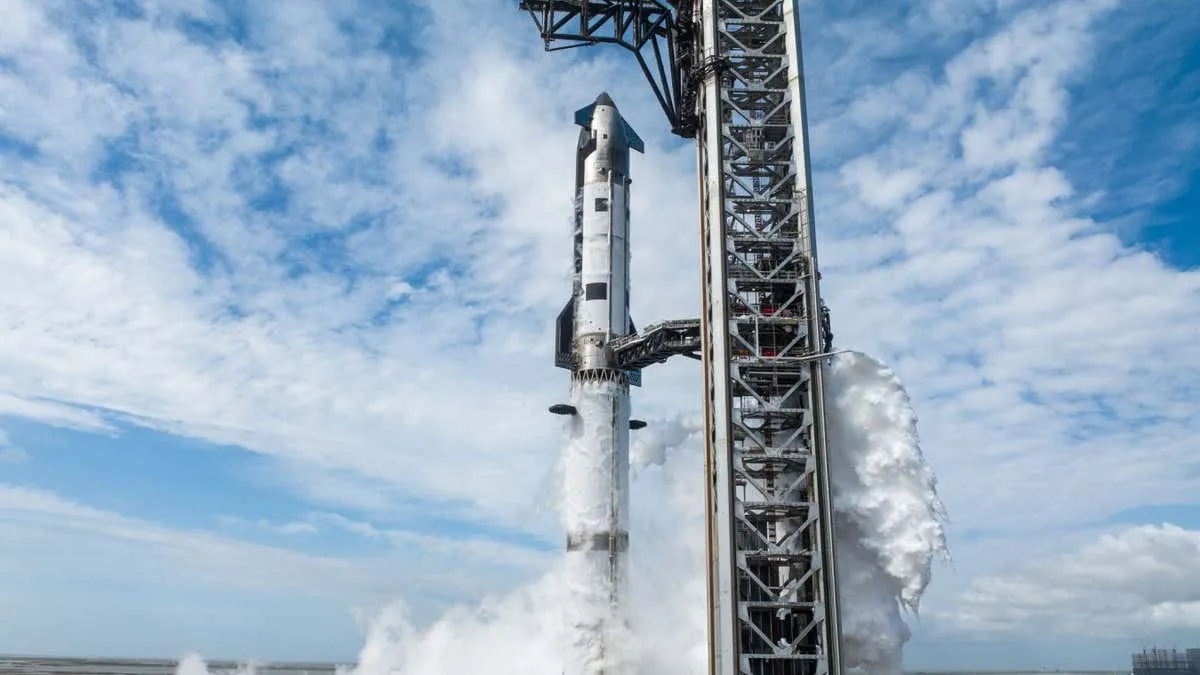
SpaceX prepares to launch a significantly upgraded Starship next week, positioning it to claim records as the tallest and most powerful rocket ever built. NASA closely monitors the test, given Starship’s central role in returning humans to the moon by 2028.
Version 3 Upgrades Boost Capabilities
The twelfth test flight, slated for as early as May 19, features version 3 models of both the upper Starship stage and the lower Super Heavy booster. These incorporate version 3 Raptor engines, previously tested in limited capacity, and lift off from a redesigned pad at Starbase in Texas.
Super Heavy version 3 now uses three enlarged grid fins—reduced from four but 50 percent larger—for precise atmospheric reentry and landing. Starship version 3 includes an expanded propellant tank, in-orbit refueling systems, and enhanced heat shield tiles for reentry.
The full stack stands at 124 meters tall, exceeding the previous version 2 by 1 meter. It surpasses NASA’s 98-meter Space Launch System and the 111-meter Saturn V from the Apollo era.
Unprecedented Thrust Power
Generating 75,000 kilonewtons of thrust—nearly double the SLS’s 39,000 kilonewtons—Starship version 3 becomes the most powerful rocket in history. Alistair John at the University of Sheffield, UK, calculates that the stack’s peak engine output exceeds all electricity generation in Germany. “It’s massive,” John states.
Critical for NASA Artemis Moon Missions
Starship supports satellite deployments and future Mars missions, as outlined by SpaceX CEO Elon Musk. NASA selected it as one of two commercial landers for the Artemis program, alongside Blue Origin’s design.
Following the uncrewed Artemis I in 2022 and crewed Artemis II lunar flyby earlier this year—the farthest human spaceflight from Earth—a recent NASA document outlines Artemis III. Crew will launch in Orion atop SLS, rendezvous in low Earth orbit with Starship or Blue Origin landers, then proceed to the lunar surface. Artemis IV targets a 2028 landing.
Fail-Fast Development Drives Progress
SpaceX employs a rapid iteration approach, with six successes and five failures across 11 prior tests. Peter Shaw at Kingston University London views SpaceX as on track for Artemis. “Rocket science is difficult. It’s challenging. It’s complex,” Shaw says. “Can they do it? Yes. Can they do it within the timeline? There’s a lot to be quietly confident about. Even if you have another failure or two, or five… they’ll learn from it, they’ll iterate it and they’ll put a new system together.”
John emphasizes the test’s importance for validating version 3, the production model underlying the Human Landing System for lunar touchdown. This variant requires moon-specific engines for lower gravity and no heat shield. “It’s in a way small, incremental improvements, but then also it’s by far the most significant version: this version 3 is what they need for the Artemis programme. The other ones have been prototypes,” John explains. “Version 3 is really the first test of the production model. Now it’s just making it reliable.”
